Voluntary Sustainability Reporting for Out-of-Scope Companies: The VSME Guide
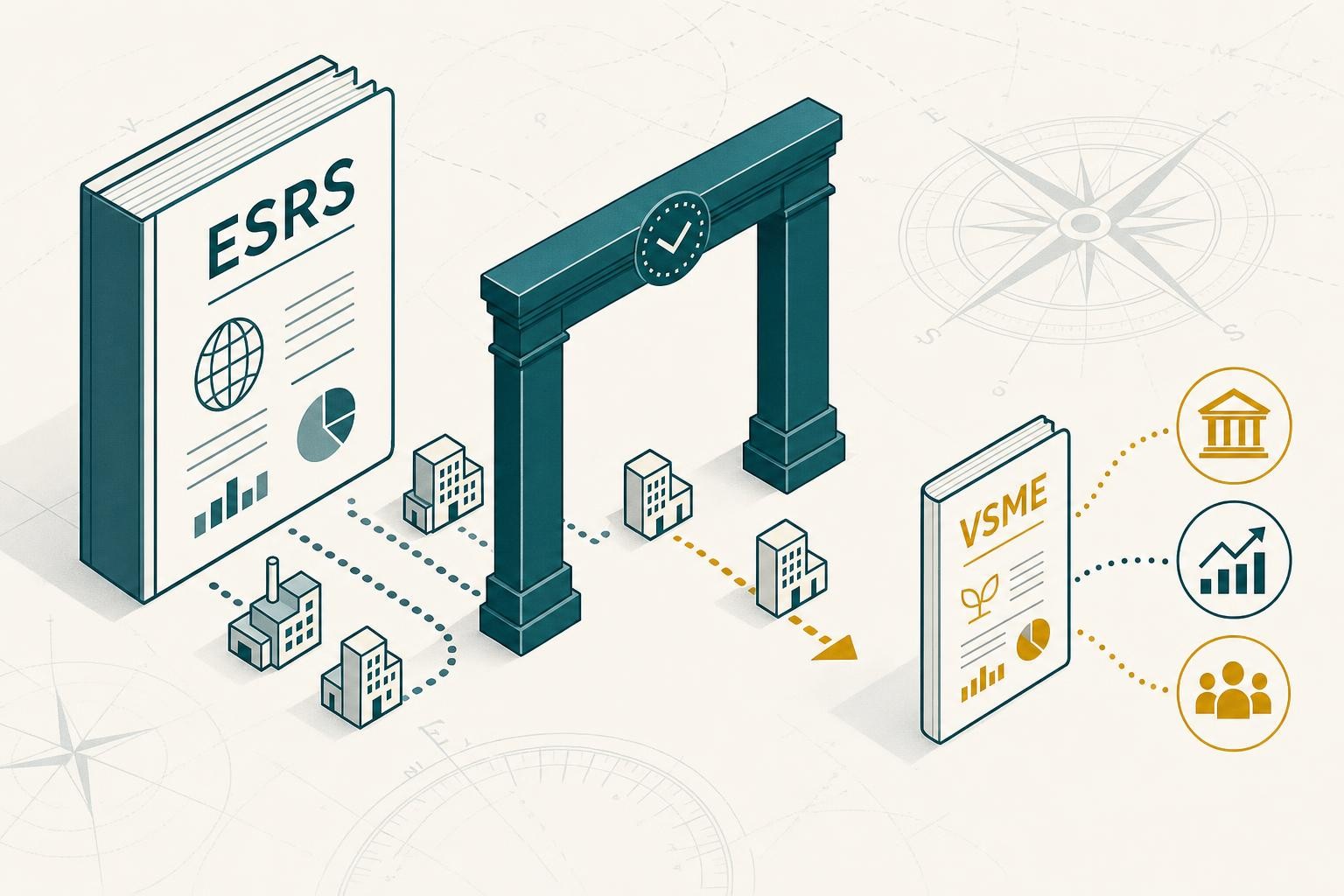
The Omnibus I Directive is now law. If your company has fewer than 1,000 employees or turns over less than EUR 450 million, you are almost certainly out of mandatory CSRD scope. That is genuinely good news - no ESRS, no double materiality assessment, no assurance requirement.
But your inbox may not have got the memo. Banks still ask for ESG data before approving green loans. Large customers still send sustainability questionnaires. Procurement teams still score suppliers on ESG criteria. Being out of legal scope does not make those requests disappear.
This guide explains who is now out of scope, why the data requests keep coming anyway, and how the VSME standard gives you a proportionate, structured way to respond - on your own terms.
Are you actually out of scope? The two-threshold test
Under the Omnibus I Directive, published in the EU Official Journal on 26 February 2026, mandatory CSRD reporting applies only to companies with more than 1,000 employees AND net annual turnover above EUR 450 million. Both criteria must be met simultaneously - it is no longer a "two out of three" test.
Under the new Omnibus I thresholds, roughly 90% of previously in-scope companies fall out of mandatory CSRD scope. Listed SMEs, which were originally scheduled for a later wave of mandatory reporting, are now fully exempt too.
Quick threshold check:
| Criterion | Mandatory CSRD threshold |
|---|---|
| Employees | > 1,000 (average, on consolidated basis) |
| Net annual turnover | > EUR 450 million |
| Both must be met? | Yes - either alone is not enough |
| Listed SMEs | Fully exempt |
If you are below either threshold, you are out. You have no legal obligation to publish a sustainability report under the CSRD.
Why you still get sustainability data requests
Being out of legal scope is not the same as being invisible to the market. Three forces keep the data requests flowing.
1. Your large customers are in scope. Companies with 1,000+ employees and EUR 450M+ turnover must report under the ESRS, including on their supply chain's environmental and social performance (Scope 3 emissions, supplier labour practices, and more). To fill those disclosures, they ask their suppliers - you - for data. This "trickle-down" effect is structural, not optional.
2. Banks are standardising around ESG. Conditions for green financing, sustainability-linked loans, and banking KYC processes are already incorporating criteria aligned with the VSME standard. A structured ESG data pack can directly affect your access to capital and the terms you receive.
3. Tenders and procurement increasingly score on ESG. In public and private procurement, sustainability criteria have moved from "nice-to-have" to awarding requirements. A company that can show structured data wins; one that says "we are working on it" loses ground.
The value chain cap — briefly. Under the Omnibus I Directive, companies with fewer than 1,000 employees have a statutory right to decline sustainability data requests that exceed the scope of the VSME standard. So the VSME is both a ceiling on what large reporters can demand and a floor for what you should be ready to provide. Our separate guide on the value chain cap covers that protection in detail.
What is the VSME standard?
The Voluntary Sustainability Reporting Standard for non-listed SMEs (VSME) was developed by EFRAG and adopted as a European Commission Recommendation on 30 July 2025. It gives smaller companies a single, standardised format for responding to ESG data requests - replacing the fragmented landscape of ad hoc questionnaires that currently costs SMEs time and money with every new request.
The VSME is deliberately lighter than the full ESRS framework used by large CSRD reporters:
- No double materiality assessment required. Instead, it uses an "if applicable" principle - you only report on topics that genuinely apply to your business. A 20-person software company does not need to report on biodiversity or water consumption if those topics are irrelevant.
- No mandatory external assurance.
- No sector-specific standards. One framework covers all industries.
- Free digital template. EFRAG provides a free Excel template (version 1.2.0, available in 11 EU languages) with built-in validation and an optional XBRL export for machine-readable reporting.
Basic Module vs Comprehensive Module
The VSME is structured around two tiers: a Basic Module of 11 disclosures (B1-B11) and a Comprehensive Module that adds 9 more (C1-C9). Completing the Basic Module is a prerequisite for the Comprehensive Module - you cannot skip ahead.
| Basic Module (B1–B11) | Comprehensive Module (C1–C9) | |
|---|---|---|
| Best for | Micro and small entities; first-time reporters | SMEs facing detailed bank or investor requests |
| Data points | ~50–51 across 11 disclosures | ~42 additional, ~100 total |
| Covers | Energy, GHG emissions (Scope 1–3), water, waste, workforce, health & safety, anti-corruption | Climate strategy, transition plans, climate risk, human rights policy, SFDR PAI indicators, EBA Pillar 3 data |
| Materiality assessment | Not required | Not required |
| External assurance | Not required | Not required |
| Prerequisite | None | Basic Module must be completed first |
| Typical use case | Supply chain transparency, initial bank screening | SFDR-regulated investors, EBA Pillar 3 bank requests, detailed procurement scoring |
EFRAG's analysis of 12 ESG questionnaires found that the combined Basic and Comprehensive Modules cover approximately 80% of recurring data requests from business partners. The remaining 20% tends to be sector-specific information that falls outside any sector-agnostic standard.
For most SMEs, the Basic Module is the right starting point. Add the Comprehensive Module only when a bank or major customer specifically asks for climate strategy, transition plans, or human rights due diligence.
The business case for voluntary reporting
The decision to report voluntarily is a commercial one, not a compliance one. Here is how the case stacks up.
Reasons to report
Financing access. EU banks have been standardising their lending criteria around the VSME, and providing a Basic Module report is often the fastest route to securing green financing and better interest rates. If you are applying for a sustainability-linked loan or green credit facility, a completed VSME report is increasingly the expected input.
Customer retention and tender eligibility. Large CSRD reporters need value chain data to complete their own reports. If you cannot provide it, they may look for a supplier who can. A proactive VSME report answers their questions before they even ask - and removes you from the "data gap" list that procurement teams flag.
Efficiency over time. The VSME was designed to standardise multiple uncoordinated ESG data requests, reducing the number of separate questionnaires SMEs receive. If you currently answer three or four different ESG questionnaires per year in different formats, a single VSME report can replace most of them. The first year costs effort; subsequent years cost much less.
Internal insight. The questions the VSME asks - energy consumption, GHG intensity, workforce safety, governance practices - are the same questions a well-run business should be tracking anyway. Companies that use their VSME data to identify weak spots (high energy costs, workforce safety gaps) gain a management tool, not just a compliance document.
Future-proofing. The European Commission is expected to publish a VSME delegated act in 2026, embedding the standard more firmly in EU law. Starting now means your data infrastructure is already in place when the standard becomes more widely expected.
Reasons to pause
Voluntary reporting is not free. Gathering data across energy invoices, HR records, and accounting systems takes time - typically spread across at least four internal departments. For a very small company with no sustainability data requests at all, the cost may not yet be justified.
The honest answer: if you have received zero ESG data requests in the past 12 months and have no plans to seek green financing or enter large-company supply chains, you can wait. If any of those conditions apply, the cost of not reporting is likely higher than the cost of reporting.
How to decide and get started
If the widget points you toward reporting, here is how to approach it practically.
Before opening the VSME template, collect the last two or three ESG questionnaires you have received. Note which data points recur. This tells you whether Basic alone will suffice or whether Comprehensive is needed.
Most VSME data already exists in your business — it just needs connecting. You will need: Finance/management (revenue, legal form, NACE codes), Operations/facilities (energy invoices, fuel receipts, waste records), HR (headcount, training hours, injury rates), Legal/compliance (anti-corruption policies, certifications). Assign one owner per area.
Download the free EFRAG Excel template (available in 11 EU languages at efrag.org). Work through the 11 Basic disclosures. Use the 'if applicable' principle — omit topics that genuinely do not apply to your business, and note the omission in section B01. Do not aim for perfection in year one; aim for completeness.
Once Basic is complete, review whether your bank or largest customer has asked for anything it does not cover — climate strategy, transition plans, SFDR PAI indicators, or EBA Pillar 3 data. If yes, add the Comprehensive Module. If not, Basic is sufficient.
A VSME report does not need to be published on your website (though it can be). The most practical approach is to prepare a standard data pack that you share proactively with value chain partners and lenders — replacing bespoke questionnaire responses with a single, consistent document.
The proportionality point
The VSME was designed for exactly this situation: a company that is not a large corporation, does not have a dedicated sustainability team, and should not be expected to produce a 200-page ESRS report - but does face real market pressure to demonstrate its ESG performance.
Being out of mandatory CSRD scope is not a reason to ignore sustainability data. It is a reason to respond proportionately. The VSME gives you the structure to do that without over-engineering it.
Related reading

CSRD Penalties and Enforcement: Who Actually Checks Your Sustainability Statement - and What Happens If It's Wrong
There is no EU-level CSRD fine. Enforcement runs entirely through national law, which means 27 different supervisors, 27 penalty ceilings and 27 answers to "who is personally liable". With Wave 1 FY2024 reports now under review, here is how the enforcement map actually looks.

Your Sustainability Statement and Your Packaging Are Now Legally Coupled: What EmpCo Means for CSRD Reporters
From 27 September 2026, EU consumer law reads your ESRS E1 data against your marketing claims. Here's what the EmpCo Directive bans, what it requires, and why your sustainability statement is now evidence.

The ESG Rating Black Box Just Got a Window: What Regulation 2024/3005 Means for Rated Companies
From 2 July 2026, EU Regulation 2024/3005 requires ESG rating providers to disclose their methodologies, materiality lens, and separate E, S and G scores. Here's what that means for IR and sustainability teams being rated.