CBAM's Definitive Period Has Started: What CSRD Reporters Need to Do Now
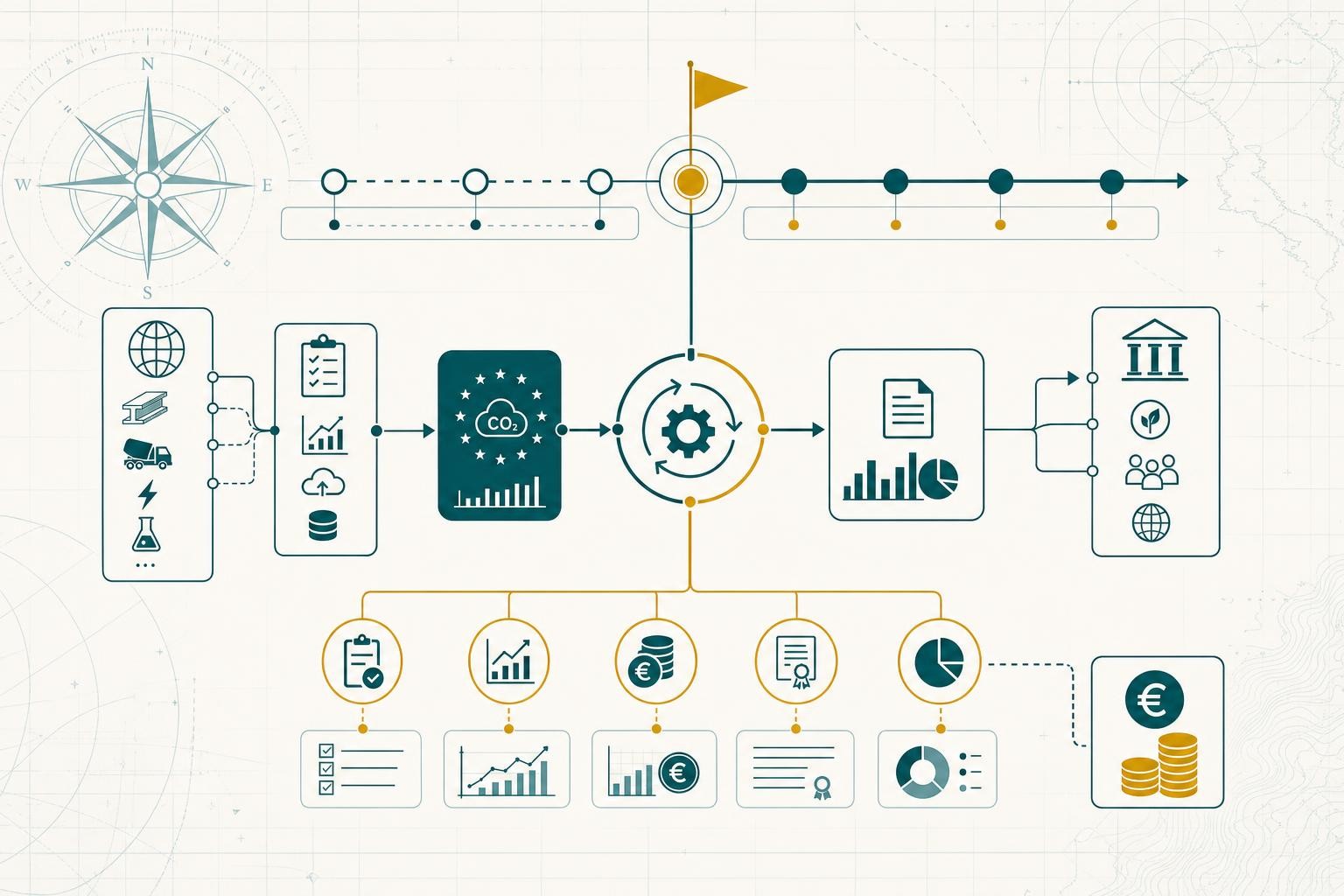
For two years, CBAM was a reporting exercise. You tracked embedded emissions in your imports of steel, cement, aluminium, fertilisers, electricity, and hydrogen - but no money changed hands. That ended on 1 January 2026.
From 1 January 2026, CBAM entered its definitive period, triggering the obligation for authorised CBAM declarants - importers above the mass threshold of 50 tonnes of CBAM goods per year - to surrender CBAM certificates corresponding to the embedded emissions of imported goods, adjusted for free allocation under the EU Emissions Trading System (EU ETS).
If your company imports CBAM goods and reports under CSRD, you are now running two compliance programmes that draw on the same underlying data. The question is whether you are treating them as one pipeline or two.
From Reporting-Only to Real Financial Exposure
CBAM's transitional phase ran from 1 October 2023 to 31 December 2025. During that period, importers were required to report their embedded emissions quarterly but were not yet obliged to purchase certificates to offset those emissions.
Four substantive compliance changes took effect on 1 January 2026, each creating operational obligations that did not exist under the reporting-only framework. The most immediate: you cannot lawfully import CBAM goods above the 50-tonne threshold without authorised declarant status, and every tonne of embedded emissions now accrues a certificate liability.
CBAM is phased in alongside the gradual removal of free EU ETS allowances for the covered sectors. In 2026, the CBAM adjustment factor is 2.5%, rising each year through to full application by 2034. The net cost today is modest - but the trajectory is steep, and the data infrastructure you build now determines your exposure for the rest of the decade.
The 2.5% CBAM factor in 2026 is not a reason to defer. The same embedded-emissions figures that generate a small certificate liability today will generate a full liability by 2034. Importers who build verified data pipelines now avoid a scramble as the factor ratchets up each year.
The 2026 Key Dates You Cannot Miss
CBAM currently covers six sectors: cement, iron and steel, aluminium, fertilisers, electricity, and hydrogen, along with selected precursors within those sectors.
| Date | Obligation | Who It Applies To |
|---|---|---|
| 1 January 2026 | Definitive regime begins; financial obligations apply | All EU importers of CBAM goods above 50 t/yr |
| 31 March 2026 | Deadline to apply for authorised CBAM declarant status (grace period — imports may continue while pending) | Importers exceeding or expecting to exceed 50 t threshold |
| 1 February 2027 | CBAM certificate purchase window opens via the common central platform | Authorised CBAM declarants |
| 30 September 2027 | First annual CBAM declaration and certificate surrender deadline (covering all 2026 imports) | Authorised CBAM declarants |
| 30 September (annually) | Annual CBAM declaration and surrender deadline for each subsequent import year | Authorised CBAM declarants |
On authorised declarant status: Importers whose cumulative annual imports of CBAM goods exceed the 50-tonne threshold must obtain the status of authorised CBAM declarant before importing CBAM goods for release for free circulation from 2026. Importers must submit CBAM authorisation applications before 31 March 2026 and are allowed to continue importing CBAM goods pending the authorisation decision.
On the certificate price: The European Commission announced the CBAM certificate price for Q2 2026 at €75.28 per tonne. This is slightly lower than the €75.36 per tonne set for Q1 2026. The Commission calculates the quarterly price based on the average clearing price of auctions under the EU ETS.
On the cost of missing data: If actual verified data is unavailable, the EU's conservative default values apply - and from 2026, those defaults carry an additional penalty markup of 10%, rising to 20% in 2027 and 30% from 2028 onward. Market analysts in 2026 report default-based costs of roughly €250+ per tonne for Indian blast-furnace steel products, versus roughly €65-€170 per tonne when verified actual emissions are used.
Why This Matters Specifically for CSRD Reporters
CSRD reporters building ESRS E1 disclosures face a well-known problem: Scope 3 Category 1 (purchased goods and services) is the hardest category to populate with credible, audit-grade data. Most companies rely on spend-based estimates or industry averages that auditors increasingly challenge.
CBAM changes that calculus for a specific and material subset of your upstream supply chain.
Your CBAM data is a subset of Scope 3 Category 1 (purchased goods), calculated at higher granularity. The embedded-emissions figures you collect for CBAM purposes - verified by an EU-accredited third-party verifier, tied to specific production installations - are exactly the kind of primary data that ESRS E1 auditors want to see.
Under CSRD, you must disclose your climate strategy (ESRS E1-1), GHG emissions (E1-6), internal carbon pricing (E1-8), and anticipated financial effects from climate regulation (E1-9). CBAM feeds all of these.
Concretely:
- ESRS E1-6 (GHG emissions): Verified CBAM embedded-emissions data upgrades your Scope 3 Category 1 calculation from spend-based estimates to installation-level primary data for your most carbon-intensive imported goods.
- ESRS E1-9 (financial effects of climate risks): Your CBAM cost forecasts quantify the financial effect of carbon pricing for E1-9.
- ESRS 2 (governance): Your CBAM governance structure is evidence of climate-risk management for ESRS 2.
Aligning your CBAM controls with your CSRD assurance scope makes sense: if you are building systems for ESRS E1 (climate-related metrics and targets), your CBAM data can feed those disclosures and vice versa.
The Double-Pipeline Problem - and How to Avoid It
Many CSRD-reporting companies have inadvertently created two separate workstreams: a CBAM compliance team (often in procurement or customs) and a CSRD sustainability team. They are collecting overlapping data, engaging the same suppliers, and producing separate outputs that never talk to each other.
Staying compliant in 2026 requires coordination across sustainability, procurement, and finance. The companies that get this right are the ones that treat CBAM embedded-emissions data as a shared asset - ingested once, used twice.
Practical Steps: Connecting Your CBAM and CSRD Data Flows
If you import more than 50 tonnes of CBAM goods per calendar year, you must hold authorised CBAM declarant status. Applications submitted by 31 March 2026 allow continued imports while the decision is pending. Check with your national competent authority — in most member states this is the customs or tax authority — and ensure your EORI number is linked to the application.
Pull your import data for cement, iron and steel, aluminium, fertilisers, electricity, and hydrogen. Identify which suppliers account for the largest share of embedded emissions — these are the relationships where investing in verified actual data (rather than default values) will deliver the biggest cost saving and the highest-quality ESRS E1 input.
Default values carry a 10% penalty markup in 2026, rising to 30% from 2028. More importantly for CSRD, default values are secondary data — auditors will flag them. Work with key suppliers to obtain verified, installation-level embedded-emissions figures. From 2026, actual emissions data used in a CBAM declaration must be verified by an EU-accredited third-party verifier.
Map the verified embedded-emissions figures from your CBAM declarations directly into your GHG Protocol Scope 3 Category 1 inventory. This upgrades the quality of your ESRS E1-6 disclosure for the most carbon-intensive portion of your upstream supply chain — and eliminates duplicate data collection. Document the data lineage clearly: auditors will want to trace the figure from the CBAM declaration to the sustainability statement.
Your CBAM declaration is due 30 September 2027 (for 2026 imports). Your CSRD sustainability statement for FY2026 will be published in early 2027. Build a single internal review and sign-off process that covers both. The same embedded-emissions data that passes CBAM verification should flow directly into your limited-assurance ESRS E1 review.
The Cost of Running Two Parallel Processes
The financial argument for integration is straightforward. From 2026, actual emissions data used in a CBAM declaration must be verified by an EU-accredited third-party verifier. The verification process includes an on-site audit of the production installation in the first year and a strict 5% materiality threshold.
That verification work is expensive. If your CSRD team is separately commissioning supplier data collection for ESRS E1 Scope 3, you are paying twice for the same underlying information - and potentially getting two different figures for the same goods.
The financial application of CBAM will be phased in gradually, mirroring the progressive phase-out of free allocation under the EU ETS through 2034. The window to build a clean, integrated data pipeline is now - while the CBAM factor is still low and the verification infrastructure is being established. By the time the factor reaches 48.5% in 2030, the cost of poor data quality will be far harder to absorb.
Key Takeaways
- CBAM's definitive period began 1 January 2026, ending the reporting-only transitional phase that ran from October 2023.
- Authorised CBAM declarant applications submitted by 31 March 2026 allow continued imports while the decision is pending.
- The first annual CBAM declaration and certificate surrender deadline for 2026 imports is 30 September 2027.
- CBAM certificate prices for Q1 and Q2 2026 were set at €75.36 and €75.28 per tonne of CO₂e respectively, calculated as the weighted average of EU ETS auction clearing prices.
- Default values carry a 10% penalty markup in 2026, rising to 30% from 2028 onward under Implementing Regulation (EU) 2025/2621.
- CBAM embedded-emissions data is audit-grade primary data for ESRS E1 Scope 3 Category 1 - route it into your CSRD disclosure rather than treating it as a separate compliance output.
- The CBAM adjustment factor is only 2.5% in 2026 - but it reaches 100% by 2034. The data infrastructure you build now determines your cost exposure for the rest of the decade.
This article is guidance to help you understand CBAM and CSRD reporting obligations. It is not legal or professional advice. Confirm specifics against the primary sources and seek qualified advice before relying on any conclusions for your own reporting.
Related reading

CSRD Penalties and Enforcement: Who Actually Checks Your Sustainability Statement - and What Happens If It's Wrong
There is no EU-level CSRD fine. Enforcement runs entirely through national law, which means 27 different supervisors, 27 penalty ceilings and 27 answers to "who is personally liable". With Wave 1 FY2024 reports now under review, here is how the enforcement map actually looks.

Your Sustainability Statement and Your Packaging Are Now Legally Coupled: What EmpCo Means for CSRD Reporters
From 27 September 2026, EU consumer law reads your ESRS E1 data against your marketing claims. Here's what the EmpCo Directive bans, what it requires, and why your sustainability statement is now evidence.

The ESG Rating Black Box Just Got a Window: What Regulation 2024/3005 Means for Rated Companies
From 2 July 2026, EU Regulation 2024/3005 requires ESG rating providers to disclose their methodologies, materiality lens, and separate E, S and G scores. Here's what that means for IR and sustainability teams being rated.