The Value Chain Cap Explained: What Large Reporters Can Ask - and What Suppliers Can Refuse
Your customer just sent a 200-question sustainability questionnaire. Or you're a sustainability lead at a large company wondering how much you can still ask your suppliers after the Omnibus. Either way, the value chain cap is the rule you need to understand - and most explainers get at least one important detail wrong.
This post unpacks the cap from both sides of the relationship: what it is, who it protects, what the VSME boundary actually covers, and what it means for Scope 3 emissions reporting.
1. What the value chain cap is - and why it exists
Before the Omnibus, large companies subject to the CSRD had broad latitude to request sustainability data from smaller suppliers in their value chain. This created a trickle-down burden: suppliers not formally in scope were still being asked to gather and report data as a condition of staying on large enterprise vendor lists. For many SMEs, these requests became duplicative, inconsistent, and resource-intensive - what many now describe as "supplier burnout."
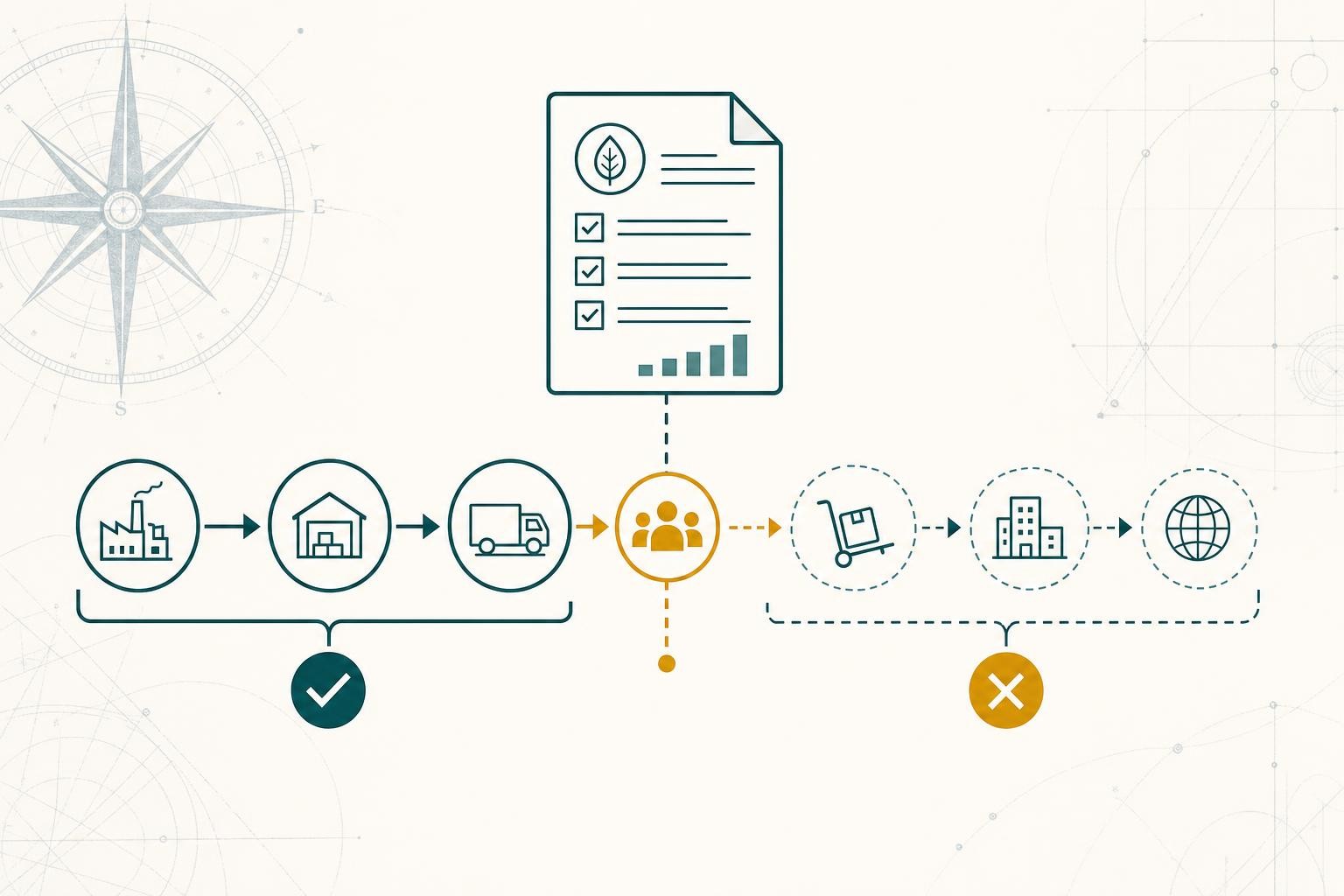
The Omnibus I Directive introduced a new "value chain cap" to limit this trickle-down effect. The cap prohibits CSRD companies from requiring companies in their value chain that have 1,000 employees or fewer to provide more sustainability information than the content of the voluntary standard to be adopted by the Commission as a delegated act.
The Omnibus I Directive was published in the Official Journal of the European Union on 26 February 2026, following official adoption by the Council of the EU on 24 February 2026.
One important nuance: the value chain cap applies only in the context of fulfilling CSRD reporting obligations and does not affect information requests for other purposes. Other regulatory frameworks - EU Deforestation Regulation, EU Forced Labour Regulation, EU AI Act, sectoral regulation - sit outside the cap. So do internal commercial purposes such as supplier qualification, customer due diligence, or insurance underwriting.
2. Who is protected - and what the VSME boundary covers
The 1,000-employee threshold
The value chain cap protects companies in the value chain with no more than 1,000 employees from the trickle-down effect, by limiting the information that undertakings in scope of the CSRD can request from them to information specified in the VSME standard.
This threshold was deliberately chosen to exempt SMEs and smaller subsidiaries from reporting requirements and reduce their administrative burden. A 250-person logistics firm, a 600-person component manufacturer, a 900-person regional retailer - all are protected, regardless of their turnover.
For SMEs, the cap creates a right to self-disclose status: a large company may rely on the supplier's own statement to determine its status. The SME can informally confirm that it employs fewer than 1,000 people and is not subject to reporting requirements. As a rule, the large customer does not have to verify this self-disclosure.
Two tiers within the cap
The protection is not one-size-fits-all. For reasons of proportionality, some disclosures marked as "necessary" for companies with 11 to 1,000 employees have been marked as "voluntary" for companies with 10 employees or fewer. This means that the value chain cap for companies with 10 employees or less includes less information than the cap for companies with between 11 and 1,000 employees. Companies with 10 employees or fewer are therefore given extra protection from the trickle-down effect.
What the VSME standard actually contains
The voluntary standard is based on EFRAG's VSME, which the European Commission officially recommended for uptake by SMEs on 30 July 2025, encouraging banks, investors, and large companies to base their ESG data requests on this standard.
The VSME standard is structured around two distinct modules. The Basic Module, intended as the entry-level for all SMEs, comprises 11 disclosures and focuses on key sustainability indicators most required by value chain partners. It includes core disclosures on GHG emissions (Scope 1 and 2), environmental metrics, own-workforce data, and anti-corruption.
The Comprehensive Module builds on the Basic Module and focuses on 9 additional disclosures often requested by banks, investors, and value chain partners. The comprehensive module includes additional information that addresses more comprehensive reporting requirements, such as Principal Adverse Impact indicators under the Sustainable Finance Disclosure Regulation, Pillar 3 disclosures, or disclosures under the Benchmark Regulation.
The VSME Basic Module contains approximately 11 disclosures covering Scope 1 and 2 GHG emissions, environmental metrics, own-workforce data, and anti-corruption - but does not require Scope 3 emissions, a materiality assessment, or a transition plan.
The final delegated act is still being finalised. The Commission must adopt the content of the voluntary standard by 19 July 2026. The draft published for public feedback in May 2026 closely follows the EFRAG VSME, but some data points may change before the act is formally adopted. Until then, Commission Recommendation 2025/1710 (based on the EFRAG VSME) provides the working reference.
3. What large reporters CAN still ask - and how to design compliant requests
The cap is a floor on what suppliers can be required to provide - not a ceiling on what reporters can ask for. It means only that reporters cannot require companies with 1,000 employees or fewer to provide certain information. Companies subject to the CSRD may still request information above the value chain cap. However, in that case, the CSRD company must clearly indicate which requested information exceeds the cap, and must inform the value chain company that it has a statutory right to decline to provide the additional information.
In practice, this means large reporters need to redesign their supplier data programmes around three principles:
Prioritise by materiality and risk. Reporting undertakings must adopt a risk-based approach, prioritising efforts to obtain information on high-risk impacts and sustainability matters commonly associated with their sector. Not every supplier needs the same depth of engagement.
Use estimates and secondary data strategically. Many organisations use secondary and static data from databases to report on supply chain emissions. This creates a good picture of where the "hotspots" are, but does not make it possible to measure improvements because it is static data. For lower-priority suppliers, sector-average emission factors are a legitimate starting point. Reserve primary data requests for the suppliers that move the needle most.
Segment your supplier base. The cap is a meaningful protection for mid-sized and smaller companies in complex global supply chains. But it also puts pressure on large enterprises to be more strategic about how they collect supplier data - and which suppliers they prioritize for sustainability assessments.
4. What smaller suppliers can refuse - and how to respond professionally
If you are a supplier with fewer than 1,000 employees and you receive a sustainability questionnaire from a large customer, here is what the law now gives you:
- The right to refuse any data request that goes beyond the VSME standard, when that request is made for CSRD reporting purposes.
- The right to self-certify your employee count - the customer generally cannot demand third-party verification.
- Legal backing: large companies subject to CSRD cannot require their suppliers or value chain partners with fewer than 1,000 employees to provide ESG information beyond what the VSME voluntary standard specifies. Any contractual provision that tries to override this is legally void.
How to respond in practice:
- Confirm your headcount in writing. A brief email stating your average employee count (below 1,000) and that you are not subject to mandatory CSRD reporting is sufficient.
- Offer VSME-level data instead. Prepare a VSME Basic Module response - it covers the core metrics your customer legitimately needs (Scope 1 and 2 emissions, basic workforce data, anti-corruption). This is a constructive response that keeps the relationship intact.
- Flag what goes beyond the cap. If the questionnaire asks for more, you can politely note which questions exceed the VSME boundary and decline those specific items, citing the value chain cap under Directive (EU) 2026/470.
- Keep records. Document the request, your response, and the date. If a dispute arises, this paper trail matters.
Our guide for suppliers has templates and worked examples for each of these steps.
5. Implications for Scope 3 emissions reporting
This is where the cap has the most strategic bite. Scope 3 indirect emissions account for approximately 75% of a company's total greenhouse gas emissions on average, according to MIT Sloan research. These indirect emissions - spread across an organisation's entire value chain - often account for the largest share of total GHG emissions. Collecting accurate Scope 3 data is crucial for setting credible reduction targets, but it is complex, resource-intensive, and often riddled with data gaps.
The value chain cap does not remove the obligation to report Scope 3 emissions under ESRS E1. What it changes is how large reporters can gather the underlying data. The practical implications:
Scope 3 categories most affected. Categories 1 (purchased goods and services), 4 (upstream transportation), and 11 (use of sold products) typically involve the most SME suppliers. These are exactly the categories where the cap bites hardest - and where spend-based or activity-based estimates will need to fill gaps.
The GHG Protocol still applies. The GHG Protocol allows the use of supplier-specific data, industry-average data, or spend-based methods. The cap effectively pushes reporters toward the latter two for their long tail of smaller suppliers, while reserving primary data requests for high-emission, high-materiality partners.
Prioritisation is now a compliance requirement, not just good practice. Reporting undertakings must adopt a risk-based approach, prioritising efforts to obtain information on high-risk impacts and sustainability matters commonly associated with their sector. This is written into the Omnibus text - not just advisory guidance.
The VSME Basic Module gives you Scope 1 and 2 - not Scope 3. The VSME Basic Module contains approximately 46 data points across 11 sections. No Scope 3, no materiality assessment, no transition plan is required. For large reporters building a Scope 3 Category 1 inventory, this means supplier-provided Scope 1 and 2 data can feed into spend-based or physical intensity calculations - but you cannot require a full product carbon footprint from a sub-1,000-employee supplier.
Use our free emissions calculator to model your Scope 3 categories and identify which suppliers warrant deeper engagement.
6. Action checklist for both sides

If you are a large CSRD reporter
- Audit your current supplier questionnaires. Identify which questions go beyond the VSME Basic or Comprehensive Module. Flag them as voluntary for sub-1,000-employee suppliers.
- Segment your supplier base by headcount, emission materiality, and sector risk. Apply deeper data requests only where justified.
- Update your supplier communication templates to include the statutory notice: if you are requesting data above the cap, you must tell the supplier they have the right to decline.
- Build a Scope 3 methodology that combines primary data from key suppliers with secondary/spend-based estimates for the long tail. Document your assumptions for assurance purposes.
- Watch for the delegated act (deadline: 19 July 2026). The final data points in the voluntary standard may differ slightly from the current EFRAG VSME Recommendation. Update your questionnaires once the act is adopted.
If you are a smaller supplier (under 1,000 employees)
- Know your headcount. The protection applies if you average fewer than 1,000 employees. Self-certification is sufficient in most cases.
- Prepare a VSME Basic Module response. This is your standard answer to any customer sustainability questionnaire. It covers what customers legitimately need and demonstrates good faith.
- Review incoming questionnaires against the VSME boundary. Questions about Scope 3 emissions, full materiality assessments, or detailed transition plans go beyond what you can be required to provide.
- Respond in writing, citing the cap. A polite, documented refusal of out-of-scope questions is legally sound and professionally appropriate.
- Note the CSRD/non-CSRD distinction. The cap covers CSRD-driven requests. Requests under other regulations (e.g. EU Deforestation Regulation) or for commercial purposes (e.g. supplier qualification) are separate - check each request's stated purpose.
The value chain cap is one of the most practically significant changes in the Omnibus package - and it runs in both directions. Large reporters must redesign their supplier data programmes around materiality and prioritisation. Smaller suppliers now have a clear legal basis to push back on excessive questionnaires. The VSME standard is the shared reference point for both.
The final delegated act content is due by 19 July 2026. Subscribe to The CSRD Brief for a plain-English summary the moment it lands.
Related reading

CSRD Penalties and Enforcement: Who Actually Checks Your Sustainability Statement - and What Happens If It's Wrong
There is no EU-level CSRD fine. Enforcement runs entirely through national law, which means 27 different supervisors, 27 penalty ceilings and 27 answers to "who is personally liable". With Wave 1 FY2024 reports now under review, here is how the enforcement map actually looks.

Your Sustainability Statement and Your Packaging Are Now Legally Coupled: What EmpCo Means for CSRD Reporters
From 27 September 2026, EU consumer law reads your ESRS E1 data against your marketing claims. Here's what the EmpCo Directive bans, what it requires, and why your sustainability statement is now evidence.

The ESG Rating Black Box Just Got a Window: What Regulation 2024/3005 Means for Rated Companies
From 2 July 2026, EU Regulation 2024/3005 requires ESG rating providers to disclose their methodologies, materiality lens, and separate E, S and G scores. Here's what that means for IR and sustainability teams being rated.