ESRS 2 General Disclosures: The Practitioner's Guide to the Mandatory Baseline

Every CSRD reporter faces the same first question: where do I start? The answer is always ESRS 2. Before you open a single topical standard - before you even know which of E1-E5, S1-S4, or G1 are material to your business - ESRS 2 General Disclosures is already in scope. It is the unconditional baseline: the one standard that applies to every in-scope undertaking, every year, regardless of what your double materiality assessment concludes.
This guide explains what ESRS 2 actually requires, how its four-pillar architecture works in practice, what the revised standards adopted on 3 July 2026 changed specifically for ESRS 2, and what your team needs to do to get ready.
What ESRS 2 is - and why it's different from every other standard
The ESRS family has two layers. ESRS 1 (General Requirements) sets the rules of the game: how to define materiality, how to structure the sustainability statement, what the value-chain boundary looks like. It contains no datapoints of its own. ESRS 2 is different: it contains the actual disclosure requirements that form the mandatory backbone of every sustainability statement.
ESRS 2 is the mandatory baseline for every company in scope, regardless of the double materiality assessment outcome. The ten topical standards - E1 Climate, E2 Pollution, E3 Water, E4 Biodiversity, E5 Circular Economy, S1 Own Workforce, S2 Value Chain Workers, S3 Affected Communities, S4 Consumers, and G1 Business Conduct - only apply where your double materiality assessment finds the topic material. ESRS 2 has no such gate.
This distinction matters enormously in practice. A company that concludes none of the topical standards are material (an unusual but legally possible outcome) still has a full ESRS 2 disclosure obligation. Conversely, a company reporting on all ten topical standards still needs ESRS 2 as the structural spine that holds everything together.
The logic is deliberate. Investors, lenders, and regulators need a common, comparable baseline - governance structures, business model descriptions, the materiality process itself - from every reporter, not just those with obvious ESG exposures. ESRS 2 provides that floor.
The four-pillar architecture
ESRS 2 organises its disclosure requirements into four reporting areas. Practitioners familiar with the former TCFD recommendations will recognise the structure immediately - it is the same four-pillar logic, now embedded in EU law.
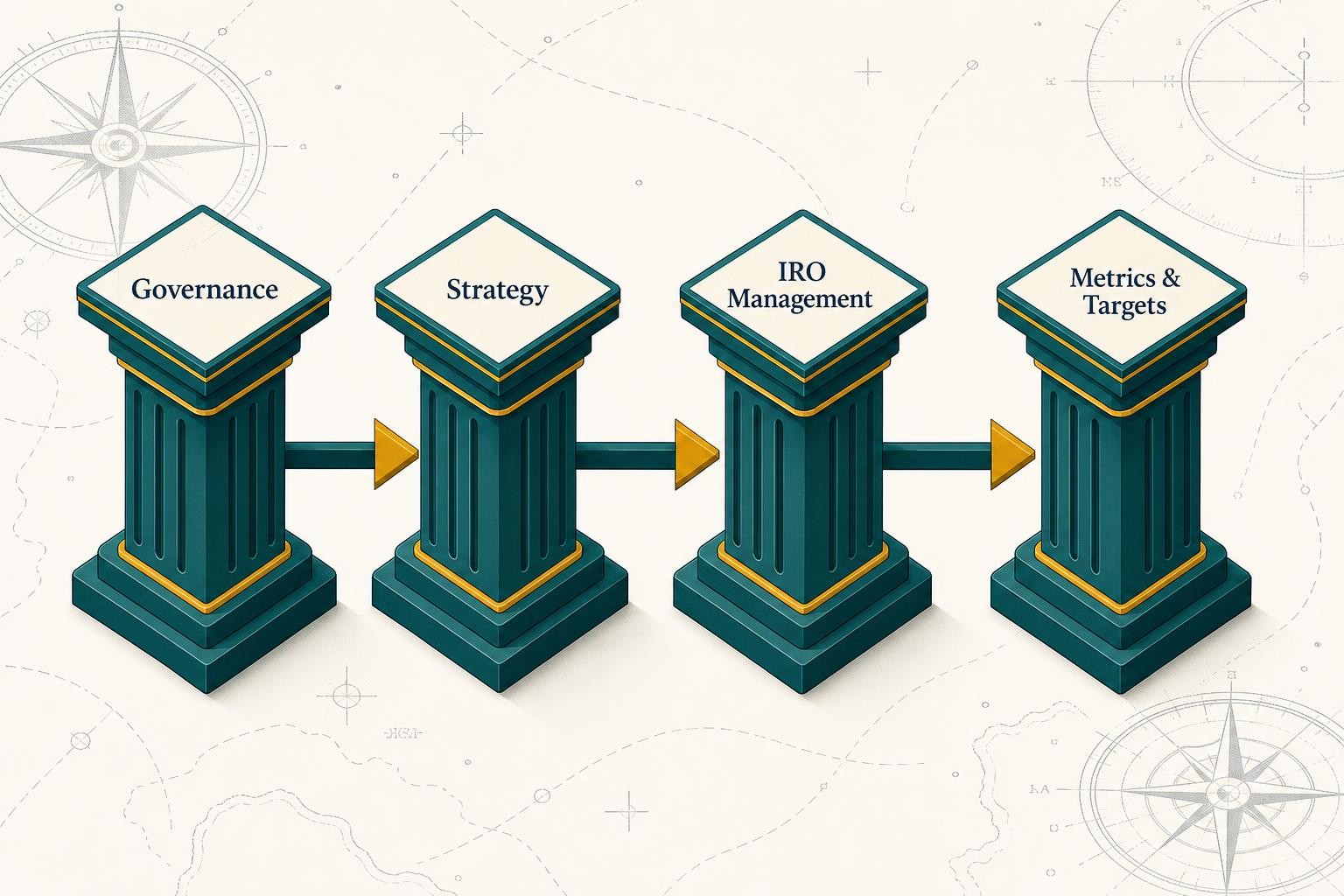
1. Governance (GOV)
The GOV disclosures establish who is responsible for sustainability at the top of the organisation and how that responsibility is exercised. The key disclosure requirements are:
- GOV-1 - The role of the administrative, management and supervisory bodies (AMSB): composition, expertise, and how sustainability is integrated into their mandate.
- GOV-2 - Information provided to those bodies: what sustainability data reaches the board, how often, and how it is used in decision-making.
- GOV-3 - Integration of sustainability performance in incentive schemes: whether and how executive pay is linked to sustainability targets.
- GOV-4 - Statement on due diligence: a narrative description of the due diligence process, particularly relevant for companies subject to the EU Corporate Sustainability Due Diligence Directive.
- GOV-5 - Risk management and internal controls over sustainability reporting: the processes that ensure the sustainability statement is reliable.
The GOV section is where auditors and investors look first. Weak governance disclosures undermine the credibility of everything that follows.
2. Strategy (SBM - Strategy, Business Model and Value Chain)
The SBM disclosures connect sustainability to the core of the business. Three requirements sit here:
- SBM-1 - Strategy, business model and value chain: market position, key products and services, the upstream and downstream value chain, and how sustainability is embedded in the strategy.
- SBM-2 - Interests and views of stakeholders: how the company engages with affected stakeholders and how their perspectives feed into strategy.
- SBM-3 - Material impacts, risks and opportunities (IROs) and their interaction with strategy and business model: the headline summary of what is material and how it shapes the company's direction.
SBM-3 is the disclosure that ties the materiality assessment to the strategy narrative. It is also where the revised 2026 standards introduced a significant new relief on anticipated financial effects - more on that below.
3. Impact, Risk and Opportunity Management (IRO)
The IRO section describes the process by which the company identifies, assesses, and manages its material sustainability matters. Two requirements apply:
- IRO-1 - Description of the processes to identify and assess material IROs: the methodology behind the double materiality assessment, including how impact materiality and financial materiality are evaluated, and how the value chain is considered.
- IRO-2 - Disclosure requirements in ESRS covered by the sustainability statement: a structured index showing which ESRS disclosure requirements the company has applied, and which topics were assessed as non-material and therefore omitted.
IRO-2 functions as the transparency map of the entire sustainability statement. It is the disclosure that allows a reader - or an auditor - to verify that the company has applied the standards correctly and has not silently dropped a topic without explanation.
4. Metrics and Targets (MDR / GDR)
The fourth pillar covers the cross-cutting requirements for how companies disclose policies, actions, metrics, and targets in relation to each material sustainability matter. In the original 2023 ESRS, these were called Minimum Disclosure Requirements (MDRs) and labelled MDR-P (Policies), MDR-A (Actions), MDR-M (Metrics), and MDR-T (Targets). The revised 2026 standards rename and consolidate them as General Disclosure Requirements (GDRs) - a structural change with real practical implications, explained in the next section.
The MDRs (now GDRs): what they actually require
The MDR/GDR layer is where ESRS 2 reaches into every material topic. For each sustainability matter your double materiality assessment identifies as material, ESRS 2 requires you to disclose:
| Requirement | 2023 Label | What You Must Disclose | If Nothing in Place |
|---|---|---|---|
| GDR-P (Policies) | MDR-P | The policies adopted to manage the material IRO: scope, key commitments, governance owner, and how they are communicated to affected stakeholders. | Disclose that no policy has been adopted and explain why. |
| GDR-A (Actions) | MDR-A | The actions and resources deployed to implement the policy: planned vs. completed actions, resources allocated (financial and non-financial), and expected outcomes. | Disclose that no actions have been taken and explain the timeline. |
| GDR-M (Metrics) | MDR-M | The metrics used to assess performance on the material IRO, including whether ESRS-prescribed metrics, sector-specific metrics, or company-specific metrics are used, and whether they have been externally validated. | Explain why no metrics are tracked. |
| GDR-T (Targets) | MDR-T | The targets set to track effectiveness of policies and actions: baseline year, target year, measurable milestones, and progress to date. | Disclose that no targets have been set and explain the reasoning. |
A critical practical point: the GDRs apply per material IRO, not per topical standard. If climate change is material and you have identified three distinct material IROs within climate (say, physical risk to assets, transition risk to revenue, and a positive impact from your renewable energy programme), you need to address policies, actions, metrics, and targets in relation to each - unless you aggregate them at a higher level (see the 2026 revision below).
If your company has not adopted a policy, taken actions, or set targets for a specific material IRO, ESRS 2 does not let you stay silent. You must disclose that fact and explain why. 'We haven't got there yet' is a valid disclosure — but it must be made explicitly.
What the revised ESRS (adopted 3 July 2026) changed for ESRS 2
On 3 July 2026, the European Commission adopted revised European Sustainability Reporting Standards, cutting mandatory datapoints by more than 60% and total datapoints by more than 70% compared to the 2023 standards. The headline numbers are striking, but for ESRS 2 specifically, the changes are more structural than numerical. Here is what practitioners need to know.
1. MDRs renamed and consolidated as GDRs
The per-topic MDR-P/A/M/T designations that appeared inside each topical standard have been consolidated into ESRS 2 itself as General Disclosure Requirements (GDR-P, GDR-A, GDR-M, GDR-T). The topical standards now cross-reference back to ESRS 2 rather than repeating the requirements. The practical effect: one authoritative set of rules for policies, actions, metrics, and targets - no more hunting through each topical standard for its own variant of the MDR language.
2. Disclosure at the IRO level or at a higher level
This is the most operationally significant change for large, complex reporters. The 2023 ESRS implied that policies, actions, targets, and metrics should be disclosed at the level of each individual material IRO. ESRS 2 (2026) clarifies that the disclosure of information on policies, actions, targets, and metrics may be provided at either the level of an individual material IRO, or at a higher level - such as groups of IROs or related topics.
In practice, this means a company with multiple material climate IROs can present a single climate policy disclosure that covers all of them, rather than repeating the policy narrative for each. The same logic applies across topics: a single human rights policy can cover material IROs across S1, S2, and S3 if it genuinely addresses all of them. This reduces duplication and makes the sustainability statement more readable - but it also raises the bar for the quality of the policy itself.
3. Incremental topical-standard requirements relocated to ESRS 2
The 2023 topical standards contained incremental disclosure requirements that added to or modified the ESRS 2 GOV-1, GOV-3, IRO-1, SBM-2, and SBM-3 requirements. These were a persistent source of confusion in first-year reporting. The revised standards relocate those incremental requirements into ESRS 2 itself or delete them. The result is a cleaner, more self-contained ESRS 2 that practitioners can apply without constant cross-referencing.
4. Anticipated financial effects: a capability-based relief in SBM-3
SBM-3 requires companies to disclose how material IROs are expected to affect financial position, performance, and cash flows. The 2023 version of this requirement was demanding - and in practice, many first-wave reporters struggled to produce credible quantitative estimates. The revised ESRS 2 introduces a structured relief: quantitative disclosure of anticipated financial effects under SBM-3 is not required where the undertaking lacks the skills, capabilities, or resources to produce it, subject to a qualitative explanation and identification of the affected financial statement line items. Companies cannot simply invoke this relief without explanation - they must disclose what they cannot quantify and why.
5. A clarified materiality filter
The revised standards convert the materiality definition into a clearer positive prohibition: companies shall not disclose ESRS-prescribed datapoints unless the information is material. This addresses a concern from first-wave reporters who felt pressure to disclose everything "just in case." The revised ESRS 2 makes clear that non-material information should be omitted, not padded in.
Timing: when does the revised ESRS 2 apply?
Upon publication in the Official Journal of the EU, the revised ESRS will enter into force on 20 November 2026 and apply to financial years beginning on or after 1 January 2027.
Before that happens, the standards must pass a scrutiny period. The revised ESRS have been presented to the European Parliament and the Council of the EU, which have two months to scrutinise the texts - extendable by a further two months - but may only reject the delegated act in full, not propose amendments. A full rejection is widely considered unlikely given the political consensus behind simplification.
For companies already reporting under the 2023 ESRS (Wave 1 reporters on FY2024 and FY2025), transitional options allow early adoption of the revised standards for financial years beginning on or after 1 January 2026. Wave 2 reporters - large companies not previously subject to NFRD - will apply the revised ESRS from FY2027 as their first reporting year.
A practical get-ready checklist for ESRS 2
The four pillars translate into a concrete preparation sequence. Work through these in order - governance and strategy disclosures inform the IRO process, which in turn determines which GDR disclosures you need.
Document which board or supervisory body members have sustainability expertise, how sustainability is on the agenda, and how often. Identify any gaps in expertise that need to be addressed before the reporting date. This feeds GOV-1 and GOV-2.
Review executive and senior management compensation structures. Identify any existing sustainability KPIs linked to pay. If none exist, document that fact — GOV-3 requires disclosure either way. If you plan to introduce linkages, start the governance process now.
SBM-1 requires a description of your upstream and downstream value chain. SBM-2 requires evidence of stakeholder engagement. Both should be documented in a form that can be audited — not just described narratively in the report.
IRO-1 requires a description of the process — not just the outcome. Document the methodology, the data sources, the thresholds used, and who was involved. The IRO-2 index then maps the outcome: which topics are material, which are not, and why.
For each material IRO identified in your DMA, check whether you have a policy, actions, metrics, and targets in place. Where you don't, decide whether to develop them before the reporting date or to disclose their absence with a clear explanation. Under the revised ESRS 2, you can group IROs — so consider whether a single policy covers multiple related IROs.
Review whether you can produce quantitative estimates of anticipated financial effects for each material IRO. If not, document the specific capability gaps. The revised ESRS 2 allows a capability-based relief — but it requires a qualitative explanation and identification of the relevant financial statement line items, not a blank omission.
Prepare the structured index of all ESRS disclosure requirements, showing which you apply, which you omit as non-material, and the basis for each omission. This is the transparency document auditors will use to verify your statement — build it early, not as a last step.
If your first reporting year is FY2027 or later, you will apply the revised ESRS 2 (in force from 20 November 2026). If you are a Wave 1 reporter on FY2026, you have transitional options — including early adoption of the revised standards. Confirm your position with legal counsel and document the decision.
The bottom line
ESRS 2 is not a warm-up act before the topical standards. It is the structural core of every CSRD sustainability statement - the governance, strategy, and process disclosures that give the rest of the report its credibility. The revised 2026 version simplifies the mechanics (fewer datapoints, consolidated GDRs, clearer aggregation rules) but does not reduce the ambition: every in-scope company must explain who governs sustainability, how it connects to the business model, how material topics were identified, and what policies and targets are in place for each one.
The companies that will find ESRS 2 manageable are those that treat it as a governance and strategy exercise first, and a reporting exercise second. The disclosures follow naturally from the underlying processes - if those processes exist.
This article is guidance to help you understand ESRS 2 General Disclosures and the revised ESRS adopted in July 2026. It is not legal or professional advice. Confirm specifics against the primary sources and seek qualified advice before relying on any conclusions for your own reporting.
Related reading

CSRD Penalties and Enforcement: Who Actually Checks Your Sustainability Statement - and What Happens If It's Wrong
There is no EU-level CSRD fine. Enforcement runs entirely through national law, which means 27 different supervisors, 27 penalty ceilings and 27 answers to "who is personally liable". With Wave 1 FY2024 reports now under review, here is how the enforcement map actually looks.

Your Sustainability Statement and Your Packaging Are Now Legally Coupled: What EmpCo Means for CSRD Reporters
From 27 September 2026, EU consumer law reads your ESRS E1 data against your marketing claims. Here's what the EmpCo Directive bans, what it requires, and why your sustainability statement is now evidence.

The ESG Rating Black Box Just Got a Window: What Regulation 2024/3005 Means for Rated Companies
From 2 July 2026, EU Regulation 2024/3005 requires ESG rating providers to disclose their methodologies, materiality lens, and separate E, S and G scores. Here's what that means for IR and sustainability teams being rated.