ESRS S2 Workers in the Value Chain: A Practical Guide for Sustainability and Procurement Teams
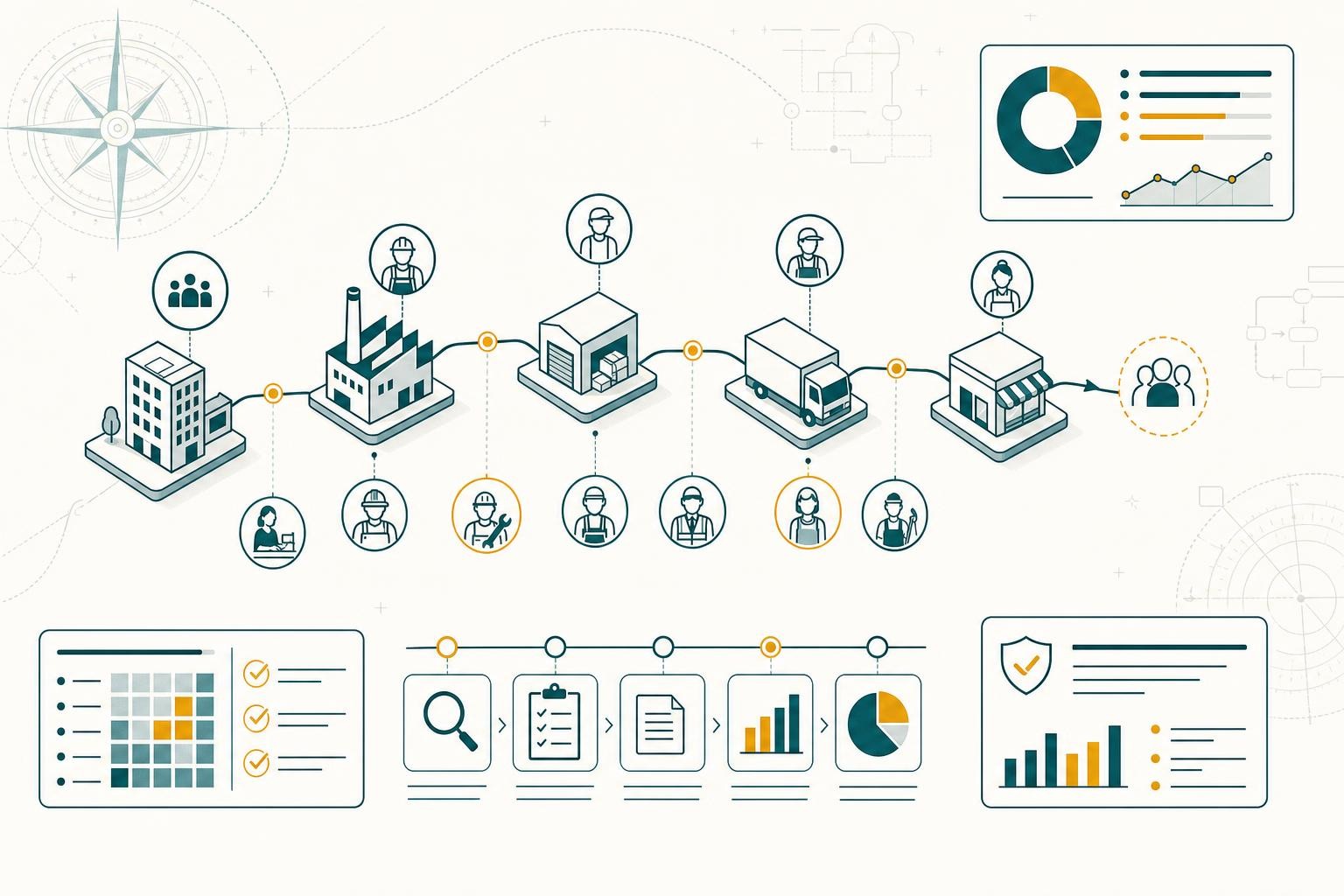
If your company is in CSRD scope, ESRS S2 is the standard that asks the harder question: what is happening to the workers behind your supply chain? Not your own employees - those are covered by ESRS S1 - but the people employed by your suppliers, subcontractors, logistics partners, and platform operators. Getting S2 right requires a clear materiality assessment, a realistic supplier engagement strategy, and an understanding of what the 2026 simplification actually changed.
This guide walks through all of it.
What is ESRS S2 and how does it differ from ESRS S1?
ESRS S2 is the topical standard for workers in the value chain under the CSRD. Its purpose is to give investors and other stakeholders a clear picture of how a company's operations and business relationships affect the labour rights and working conditions of people it does not directly employ.
ESRS S2 covers the same sub-topics as ESRS S1 Own Workforce, but applies them to workers in the upstream and downstream value chain who are not in the undertaking's own workforce. The boundary matters: this standard covers workers who are not included in the scope of 'own workforce' as set out in ESRS S1 - people who are in an employment relationship with the undertaking ('employees') and people who, for the purposes of ESRS reporting, are called 'non-employees' in the undertaking's own workforce.
In short: if they work for you, they are S1. If they work because of you - for a supplier, a subcontractor, or a business partner - they are S2.
The reporting under ESRS S2 shall be consistent, coherent and, where relevant, clearly linked with reporting on the undertaking's own workforce under ESRS S1, in order to ensure effective reporting. In practice, this means your human rights policy and supplier code of conduct should read as a coherent whole across both standards.
Who counts as a value-chain worker?
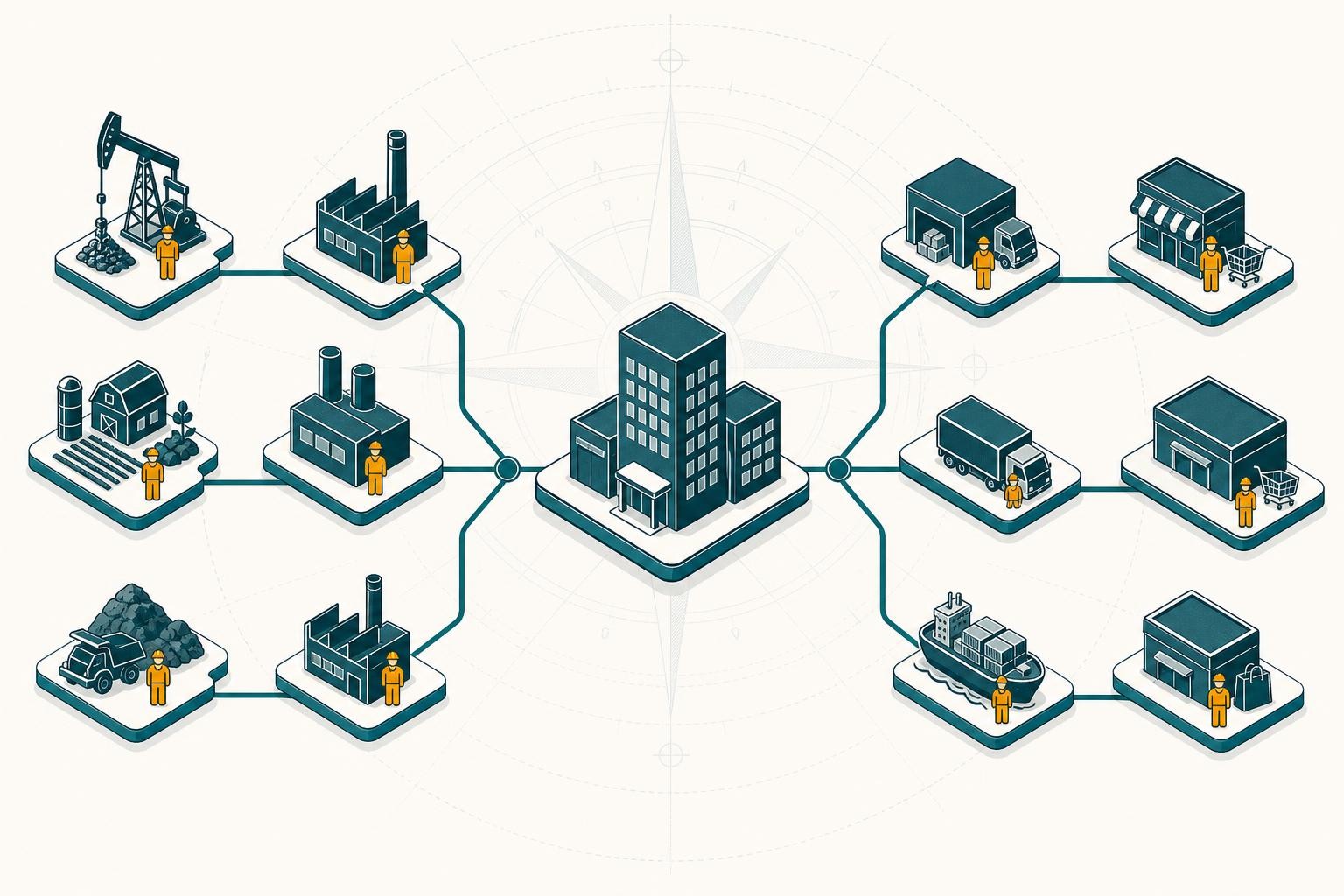
ESRS S2 covers all workers in the undertaking's upstream and downstream value chain who are or can be materially impacted by the undertaking. Such impacts may be connected with the undertaking's own operations or its upstream and downstream value chain, including impacts connected to the undertaking's products and services, as well as through its business relationships.
The EFRAG application guidance gives concrete examples of who this includes:
- Workers employed by direct and indirect suppliers
- Workers employed by subcontractors at any tier
- Platform workers and gig workers engaged through business relationships
- Workers of outsourced services working in the workplace of the undertaking (for example, third-party catering or security workers)
- Workers in downstream distribution, logistics, and retail partners
The sub-topics S2 asks you to assess span three clusters: working conditions (secure employment, working time, adequate wages, health and safety, social dialogue); equal treatment and opportunities (gender equality, training, inclusion of persons with disabilities, measures against harassment); and other labour-related human rights, including child labour, forced labour, privacy, adequate housing, and water and sanitation.
The double materiality gate: S2 only applies when it is material
This is the most important sentence in the standard: ESRS S2 applies when material impacts on and/or material risks and opportunities related to value chain workers have been identified through the materiality assessment process laid out in ESRS 2 General Disclosures.
If your double materiality assessment concludes that value-chain workers are not a material topic - because your supply chain is short, low-risk, and geographically concentrated in high-regulation markets - you do not need to report under S2 at all. You should, however, document that conclusion clearly.
For most companies with extended supply chains, particularly those sourcing from regions with weaker labour protections or relying on labour-intensive manufacturing, value-chain workers will be material. ESRS S2 also requires an explanation of how impacts on value chain workers, as well as the undertaking's dependencies on them, can create material risks or opportunities. For example, negative impacts on value chain workers may disrupt the undertaking's operations - through customers refusing to buy its products or state agencies impounding its goods - and harm its reputation.
Materiality drives everything in S2. If value-chain workers are not material, you skip the standard. If they are material, you report on all sub-topics that are material — not necessarily all sub-topics in the standard. Document your reasoning either way; auditors will ask.
The four disclosure requirements
Under ESRS 2026, S2 consolidates its disclosure requirements into four areas. Here is what each one asks for.
S2-1 - Policies related to workers in the value chain
The undertaking shall describe its policies for managing material impacts, risks and opportunities related to workers in the value chain. It shall state whether these policies cover specific groups of workers in the value chain (for example, particular age groups or workers in a particular factory or country) or all workers in the value chain.
Critically, the undertaking shall state whether its policies in relation to workers in the value chain address trafficking in human beings, forced labour or compulsory labour, and child labour. The undertaking shall also state whether it has a supplier code of conduct.
Policies do not need to be stand-alone S2 documents. A responsible sourcing policy, a supplier code of conduct, or a human rights policy that already covers these matters can satisfy S2-1 - provided you cross-reference it clearly.
S2-2 - Engagement with workers in the value chain and channels to raise concerns
The objective of this disclosure requirement is to enable an understanding of the undertaking's general approach to engagement with workers in the value chain, including the availability of channels to raise concerns or needs such as grievance mechanisms, and its approach to remedy.
The undertaking shall disclose how it engages directly with workers in the value chain, their legitimate representatives or with credible proxies, and how the perspectives of its workers in the value chain inform its decisions or activities aimed at managing the actual and potential impacts on workers in the value chain during the reporting year.
In practice, direct engagement with workers in a tier-2 or tier-3 supplier is rarely feasible. The standard acknowledges this: credible proxies - trade unions, civil society organisations, audit bodies - can substitute for direct engagement where direct access is not possible.
S2-3 - Actions and resources
The undertaking shall describe the key actions and resources used to manage its material positive and negative impacts, risks and opportunities related to workers in the value chain. This includes how it tracks and assesses the effectiveness of those actions.
The simplified ESRS 2026 restructured this requirement. For the sub-topics assessed as material for this Standard, subject to the relevant privacy regulation, the undertaking shall disclose human rights incidents connected to workers in the value chain identified in the reporting period. This is a new, explicit datapoint that was not present in the original 2023 standard in the same form.
S2-4 - Targets related to workers in the value chain
The undertaking shall disclose qualitative or quantitative targets related to workers in the value chain in accordance with ESRS 2 GDR-T. S2-4 allows qualitative or quantitative targets depending on what is material and useful for tracking effectiveness. If you have no targets yet, you disclose that fact - you are not required to invent targets to fill the box.
| Disclosure Requirement | What it asks for | Conditional on… |
|---|---|---|
| S2-1 Policies | Policies covering value-chain workers; whether they address forced labour, child labour, trafficking; existence of supplier code of conduct | S2 being material; disclose absence if no policy exists |
| S2-2 Engagement & channels | How you engage workers or credible proxies; grievance mechanisms; approach to remedy | S2 being material |
| S2-3 Actions & resources | Key actions taken; effectiveness tracking; human rights incidents in the reporting period | S2 being material; sub-topics assessed as material |
| S2-4 Targets | Qualitative or quantitative targets; can be omitted if none exist (with disclosure of that fact) | S2 being material; targets having been set |
What ESRS 2026 changed for S2
On 3 July 2026, the European Commission adopted the finalised version of the revised European Sustainability Reporting Standards (ESRS). The revised ESRS streamline processes by reducing the number of mandatory datapoints by more than 60% and the total number of datapoints by more than 70%. These changes are expected to reduce reporting costs by more than 30% per company.
Entities subject to the scope of the CSRD must apply ESRS 2026 for financial years beginning on or after 1 January 2027. Large listed companies that have been subject to the CSRD since 2024 may voluntarily apply the revised standards as early as their reporting for the 2026 financial year.
For S2 specifically, the key changes are:
- Consolidation of disclosure requirements. The original S2 had five numbered disclosure requirements (S2-1 through S2-5). ESRS 2026 merges the engagement and grievance channel requirements into a single S2-2, reducing the structural complexity.
- Conditionality. Many datapoints are now explicitly conditional on policies, actions, or targets already existing. If you have not adopted a policy on a given sub-topic, you disclose that fact rather than constructing a policy to report on.
- Less granular narrative. Granularity has been removed from narrative disclosures, reducing the number of sub-bullets required within each disclosure requirement.
- New human rights incidents datapoint. The simplified standard introduces an explicit requirement to disclose substantiated human rights incidents connected to value-chain workers - a clearer, more targeted ask than the original text.
- Top-down materiality. The revised approach to materiality is the most significant practical change to the ESRS, as a top-down approach is emphasised. This means that the company starts from its business model and strategy and focuses on areas where material impacts, risks and opportunities are likely.
Scrutiny period still running. The ESRS 2026 delegated act was adopted on 3 July 2026 but must pass a two-month scrutiny period by the European Parliament and Council (extendable by a further two months) before publication in the Official Journal. The standards are expected to be confirmed without substantive change, but monitor the Official Journal for the final publication date before locking in your FY2026 early-adoption decision.
The value chain cap: what it means for S2 data collection
This is where S2 gets practically difficult - and where the Omnibus I Directive introduced a rule that every procurement and sustainability team needs to understand.
Reporting undertakings shall not seek to obtain from undertakings in their value chain with fewer than 1,000 employees any information beyond what is specified in the voluntary standards for undertakings. The value chain cap is set at 1,000 employees, and there are new, explicit protections for smaller suppliers.
Protected undertakings have a statutory right to refuse any request exceeding those limits. If a reporting undertaking nevertheless seeks additional information, it must inform the protected undertaking both of the extra information requested and of its right to decline.
The voluntary standard that defines the ceiling is the VSME (Voluntary SME Standard), developed by EFRAG and adopted by Commission Recommendation in July 2025. The VSME standard now acts as a statutory "Value-Chain Cap." It is no longer just a recommendation; it is a legal limit defining the maximum sustainability information that can be requested from SMEs and small mid-caps.
What this means in practice for S2
The cap creates a genuine data gap for S2. Most of the workers you need to report on - those employed by tier-1 and tier-2 suppliers - work for companies that are almost certainly under 1,000 employees. You cannot demand full ESRS-level labour data from them.
Here is how to work within the constraint:
Use what the VSME does cover. The VSME Basic module includes information on health and safety incidents, employment types, and whether a code of conduct exists. That is a starting point for S2-1 and S2-3.
Use estimates, sampling, and sector proxies. The ESRS explicitly acknowledges that value-chain data is often unavailable directly. The undue cost or effort principle was introduced to reduce reporting costs and complexity when gathering data. According to this principle, companies can use information that is reasonable and supportable from internal and external sources. Sector-level labour risk indices, ILO country data, and third-party audit results (where already available) are all legitimate inputs.
Focus on high-risk tiers. Reporting undertakings must adopt a risk-based approach, prioritising efforts to obtain information on high-risk impacts and sustainability matters commonly associated with their sector. You do not need uniform data across every supplier - concentrate your engagement where the risk is highest.
Distinguish CSRD reporting from due diligence. The VSME cap applies specifically to data requested for CSRD reporting. However, under the CSDDD, companies must still engage suppliers to identify and mitigate human rights or environmental risks. This obligation stands even if the specific data points required for risk management fall outside the VSME standard.
Use self-declarations for size verification. Reporting undertakings may rely on a simple self-declaration from value-chain actors to determine their size. No further verification is required unless the reporting undertaking knows, or can reasonably be expected to know, that the declaration is manifestly incorrect.
CSRD scope reminder: who must report at all?
Before investing heavily in S2 preparation, confirm your company is actually in mandatory scope. After the Omnibus I Directive (EU) 2026/470, which entered into force on 18 March 2026, CSRD mandatory reporting applies only to companies exceeding both 1,000 employees AND EUR 450 million net turnover. An estimated 90% of companies that were originally preparing for CSRD are now exempt from mandatory reporting.
If you are a supplier receiving data requests from a large customer, see our guide to the value chain cap for a full explanation of your rights and how to respond proportionately.
Get-ready checklist for S2
Use this checklist to structure your S2 preparation. The order matters: materiality first, then data, then disclosure.
Identify which sub-topics (working conditions, equal treatment, other human rights) are material for your specific value chain. Document the reasoning. If value-chain workers are not material, record that conclusion and stop here — S2 does not apply.
Identify which supplier tiers, geographies, and worker categories carry the highest labour risk. Use sector risk indices, ILO country data, and existing audit results. You do not need uniform data from every supplier — concentrate on where risk is highest.
Check whether your responsible sourcing policy, supplier code of conduct, or human rights policy explicitly addresses forced labour, child labour, and trafficking. If gaps exist, update the policy — do not create a new stand-alone document unless necessary.
Confirm that workers in your supply chain have a realistic way to raise concerns — whether through your own channel, a third-party mechanism, or a sector-level scheme. A grievance channel that exists on paper but is inaccessible to non-employees will not satisfy S2-2.
For suppliers with fewer than 1,000 employees, limit data requests to what the VSME covers. For gaps, use estimates, sampling, sector proxies, and third-party audit data. Document your methodology — auditors will ask how you arrived at your disclosures.
ESRS 2026 introduces an explicit requirement to disclose substantiated human rights incidents connected to value-chain workers. Set up an internal process to identify, substantiate, and aggregate incidents by severity before your first reporting period.
If you have targets related to value-chain worker outcomes (e.g. supplier audit coverage, grievance resolution rates), document them for S2-4. If you have none, you disclose that fact. You are not required to invent targets to fill the disclosure.
Frequently asked questions
Does ESRS S2 apply to every company in CSRD scope?
No. S2 is a topical standard gated by double materiality. It only applies if your materiality assessment finds that value-chain workers are a material topic — meaning your operations or business relationships have, or could have, material impacts on them, or that related risks and opportunities are material to your business. If value-chain workers are not material, you do not report under S2, but you should document that conclusion.
What is the difference between ESRS S1 and ESRS S2?
ESRS S1 covers your own workforce — employees and non-employees (such as agency workers and self-employed contractors) who work under your direction. ESRS S2 covers everyone else in your value chain who is materially affected by your operations: workers employed by suppliers, subcontractors, logistics partners, platform operators, and other business relationships, both upstream and downstream.
My supplier has fewer than 1,000 employees. Can I still ask them for labour data?
Yes, but only up to the ceiling set by the VSME standard. You cannot require them to provide data beyond what the VSME specifies for CSRD reporting purposes. If you ask for more, you must tell them what you are asking for and that they have a statutory right to refuse. For gaps in your S2 disclosure, use estimates, sector proxies, third-party audit results, or ILO country data instead.
When do ESRS 2026 apply?
ESRS 2026 are mandatory for financial years beginning on or after 1 January 2027. Wave 1 companies (large listed entities already reporting under the original 2023 ESRS) may voluntarily adopt the simplified standards for FY2026. The delegated act adopted on 3 July 2026 is currently in a two-month parliamentary scrutiny period before publication in the Official Journal.
What happens if I have no targets for value-chain workers?
You disclose that fact. ESRS 2026 makes S2-4 conditional on targets having been set. If you have not adopted targets, you state this in your sustainability statement. You are not required to create targets simply to satisfy the disclosure requirement — though your auditor may ask about your reasoning.
Does the value chain cap also limit what I can ask for under the CSDDD?
No. The cap applies specifically to data requested for CSRD sustainability reporting. Under the Corporate Sustainability Due Diligence Directive (CSDDD), you must still engage suppliers to identify and mitigate human rights and environmental risks, even if the specific data points fall outside the VSME standard. The two obligations are distinct.
This article is for information purposes only and does not constitute legal or professional advice. Consult a qualified adviser for guidance specific to your situation. Regulatory positions reflect the state of play as of July 2026; confirm against the final published text of the ESRS 2026 delegated act before filing.
Related reading

ESAP European Single Access Point: What CSRD Reporters Need to Know Before 2028
ESAP goes live in July 2027. CSRD sustainability data follows in January 2028. Here's what the phased rollout means for your reporting process - and what to fix now.
CBAM's Definitive Period Has Started: What CSRD Reporters Need to Do Now
CBAM's financial obligations began 1 January 2026. If you import CBAM goods and report under CSRD, your embedded-emissions data pipeline should be feeding both - not running in parallel.

ESRS S4 Consumers and End-Users: A Practitioner's Guide for CSRD Reporters
ESRS S4 covers your company's impacts on consumers and end-users. Here's what it requires, how the double materiality gate works, and why the 2025-2026 deferral is not the same as an exemption.