ESRS S1 Own Workforce: A Practical Guide to the Social Pillar of CSRD Reporting
When companies think about CSRD, climate data tends to dominate the conversation. But the social pillar - specifically ESRS S1 on own workforce - is where many reporters find the real data challenge. The concepts are not new. The difficulty is that the data has never been pulled together in one place, across every entity, in a consistent format.
This guide covers what ESRS S1 requires, who is in scope, what the simplified ESRS 2.0 changes (and what it does not), the metrics you will need to collect, and the practical steps to get ready.
What is ESRS S1 and what does it cover?
ESRS S1 is the European Sustainability Reporting Standard that governs how organisations report on their own workforce. It sits within the CSRD and covers everything from employee characteristics and working conditions to training, health and safety, and pay equity.
ESRS S1 covers two categories of disclosure: impacts, risks and opportunities management (the qualitative picture - policies, processes, actions), and metrics and targets (the quantitative picture - the data that proves the policies are working).
The sub-topics span three broad areas:
- Working conditions - secure employment, working time, adequate wages, social dialogue, collective bargaining and freedom of association, work-life balance, health and safety.
- Equal treatment and opportunities - gender equality and equal pay, training and skills development, employment of persons with disabilities, measures against violence and harassment, diversity.
- Other work-related rights - child labour, forced labour, adequate housing and privacy.
The current ESRS S1 standard includes 17 disclosure requirements across two categories: impacts, risks and opportunities management (S1-1 to S1-4) and metrics and targets (S1-5 to S1-17).
Who counts as "own workforce"?
This is one of the most common points of confusion. "Own workforce" is broader than your payroll.
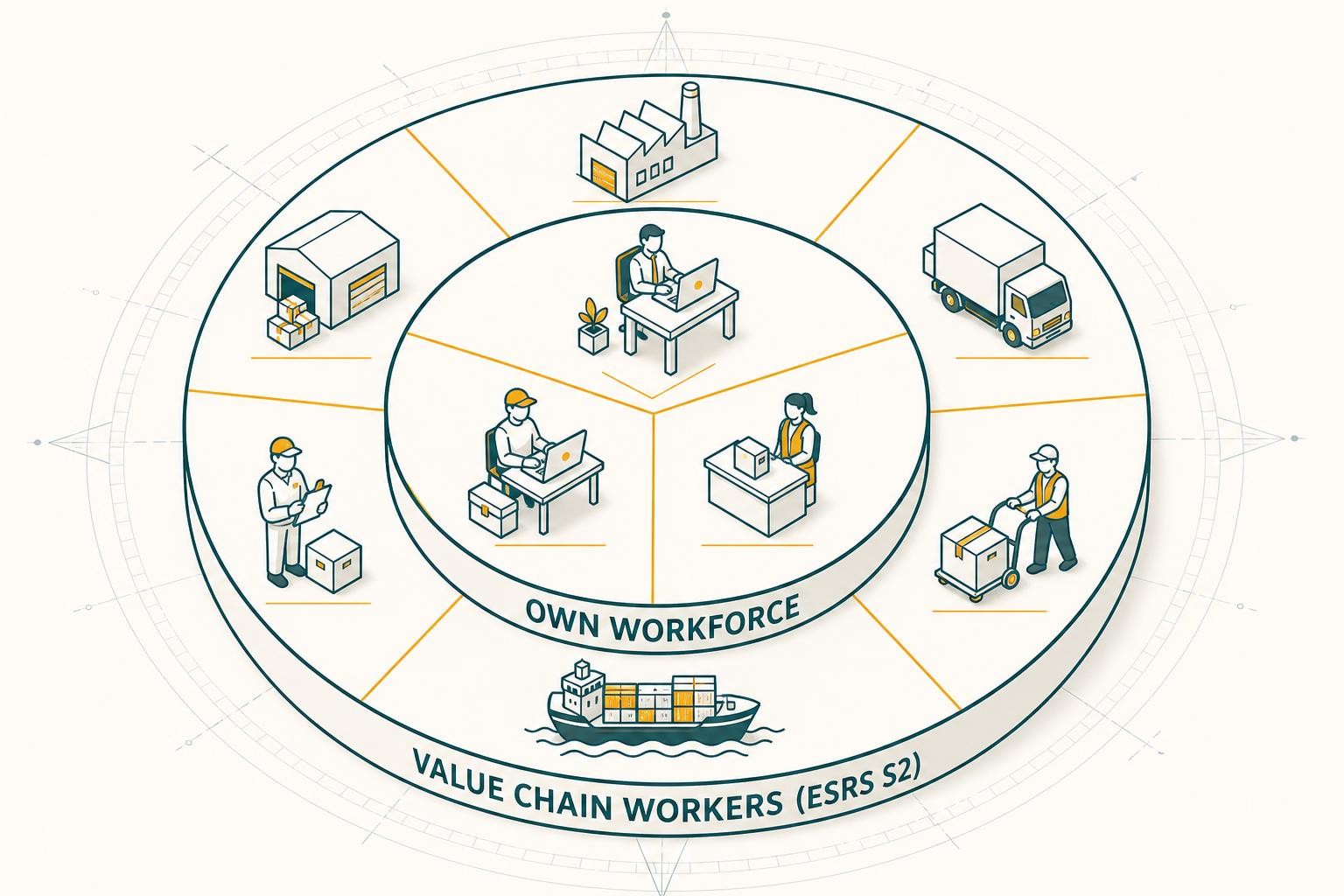
The standard covers an undertaking's own workforce, which includes both people who are in an employment relationship with the undertaking ("employees") and non-employees who are either people with contracts with the undertaking to supply labour ("self-employed people") or people provided by undertakings primarily engaged in "employment activities" (NACE Code N78).
In plain terms, the non-employee category captures two groups:
Self-employed contractors - examples include contractors hired to perform work that would otherwise be carried out by an employee, contractors working in a public area (e.g., on a road or street), and contractors hired to deliver work directly at the workplace of a client.
Agency and posted workers - people employed by a third party engaged in "employment activities", which could include people who perform the same work that employees carry out, such as those who fill in for employees who are temporarily absent or who may be dispatched temporarily from another EU Member State to work for the undertaking ("posted workers").
One important clarification: information about the persons referred to as "non-employees" in the undertaking's own workforce shall not affect their status under applicable labour law. Reporting on them under ESRS S1 does not reclassify them as employees.
The standard does not cover workers in the undertaking's upstream or downstream value chain. Those workers are covered in ESRS S2 Workers in the Value Chain.
The materiality gate: when does S1 apply?
The sustainability statement shall include information in relation to ESRS S1 Own Workforce if this topic relates to material impacts, risks and opportunities. If not all the sub-topics prescribed by this standard are to be reported following the materiality assessment, the rules in ESRS 1 General Requirements apply.
In practice, own workforce is almost always material. According to a study by DRSC & Deloitte analysing 77 sustainability reports from DAX/MDAX/SDAX companies, ESRS S1 was classified as material by all companies (100%) - making S1 one of the few standards with universal materiality in that sample.
That said, the materiality gate still matters at the sub-topic level. ESRS S1 continues to follow the double materiality approach, but it makes clearer that once "own workforce" is considered material, companies are expected to disclose key baseline workforce information - especially employee characteristics - and to disclose non-employee information when those workers are connected to material impacts, risks, or opportunities.
The practical implication: once the topic is material, certain baseline datapoints (employee headcount, gender breakdown, turnover) become effectively mandatory. Other sub-topics - adequate wages, health and safety, training - are triggered only if those specific sub-topics are themselves material.
Don't treat the materiality gate as a way to avoid S1 entirely. The more useful question is: which sub-topics within S1 are material for your business? A manufacturing company with high injury rates will find health and safety material. A professional services firm with a large gender pay gap will find equal pay material. Work through each sub-topic systematically in your double materiality assessment.
What the simplified ESRS 2.0 changes - and what it doesn't
The ESRS are being revised as part of the Omnibus simplification package. Here is where things stand as of mid-2026.
The process so far:
- Building on CSRD Wave 1 feedback and based on the mandate from the European Commission, EFRAG completed its simplification exercise at the end of November and published the draft amended ESRS on 3 December 2025, after an extensive input gathered that included 60 days of public consultation.
- On 6 May 2026, the European Commission launched a consultation on the draft final versions of the revised ESRS, opening a four-week public feedback period.
- Stakeholders could submit feedback until 3 June 2026. The Commission has indicated it will adopt the two delegated acts "as soon as possible" after the consultation closes.
- Once the Commission adopts the final delegated act, which is expected in June or July, the draft act will be subject to a scrutiny period by the European Parliament and Council of the European Union for at most four months.
- Once in force, the revised ESRS will apply to financial years beginning on or after 1 January 2027.
⚠️ Note: The final legal text is not yet published. The analysis below reflects the draft delegated act published for consultation in May 2026. The Commission may make further adjustments before adoption.
What changed for S1 specifically:
Building on lessons learnt in 2024 by Wave 1 reporters and on extensive multistakeholder evidence from the public consultation (more than 700 respondents), EFRAG delivered a set of draft simplified standards introducing substantial flexibility, reliefs and phasing-in, as well as reducing the mandatory datapoints by 61%.
For ESRS S1 specifically, the simplified version limits human rights disclosures to significant incidents, makes non-employee disclosure conditional on materiality, and introduces country-specific wage benchmarks for the adequate wages requirement.
The simplified draft published by EFRAG in November 2025 reduces the disclosure requirements from 17 to 16, with mandatory application expected from financial year 2027.
Key point: the simplification reduces the datapoint burden and increases reliance on materiality. It does not remove the S1 topic or its core workforce disclosures. For organisations currently in scope, the core disclosure requirements of ESRS S1 remain in place. The Omnibus reforms have streamlined what needs to be reported, but the underlying framework - workforce policies, competence data, training metrics, pay equity - is unchanged.
Core metrics and disclosure requirements
Here is a practical summary of the quantitative metrics most reporters will need to collect for S1, once own workforce is material.
Employee characteristics (S1-5 in the simplified draft)
The draft explicitly requires headcount by gender and by key countries, contract type breakdowns, employee turnover, and a description of the methodology used to compile employee data (end-of-year vs. average).
Reporters must break down by country for countries with 50 or more employees that are also in the top ten by employee count.
The draft defines employee turnover as the number of employees who leave voluntarily or due to dismissal, retirement or death in service, divided by the average employee headcount.
Non-employee characteristics (S1-6)
The disclosure requires the total number of non-employees in the undertaking's own workforce - either people with contracts with the undertaking to supply labour ("self-employed people") or people provided by undertakings primarily engaged in "employment activities" (NACE Code N78). Reporters must also explain whether the figure is headcount or FTE, and whether it is end-of-period or an average.
Collective bargaining and social dialogue (S1-7)
The objective of this disclosure requirement is to enable an understanding of the coverage of collective bargaining agreements and social dialogue for the undertaking's employees. The metric is the percentage of employees covered by collective bargaining agreements, reported by geography where relevant.
Diversity metrics (S1-8)
The undertaking shall disclose the gender distribution in number (headcount) across management levels and the overall workforce.
Adequate wages (S1-9)
The draft asks whether employees are paid an adequate wage and which benchmark is used, with country-level context. The benchmark cannot be lower than applicable minimum wage levels in the EU, or credible living wage or adequate minimum wage references outside the EU.
Training and skills development (S1-12)
S1-13 (in the original numbering) requires organisations to disclose the extent to which training and skills development is provided to employees - specifically, the percentage of employees who participated in regular performance and career development reviews, broken down by gender.
Health and safety (S1-13 in the simplified draft)
Where health and safety is material, reporters must disclose work-related incidents, including fatalities and lost-time injury rates. The disclosure requires the number of work-related incidents and/or complaints and severe human rights impacts within the own workforce, and any related material fines, sanctions or compensation for the reporting period.
Gender pay gap and remuneration (S1-14 in the simplified draft)
The gender pay gap is reported as the difference in average gross hourly earnings between male and female employees, expressed as a percentage. The standard also requires the ratio between the remuneration of the highest-paid individual and the median remuneration for all employees.
| Metric | Disclosure Req. (simplified) | Trigger | Format |
|---|---|---|---|
| Total employees by gender | S1-5 | S1 material | Headcount / FTE |
| Employees by country (top 10 + ≥50) | S1-5 | S1 material | Headcount |
| Employee turnover rate | S1-5 | S1 material | % (leavers / avg. headcount) |
| Non-employee worker count | S1-6 | Non-employees material | Headcount or FTE |
| Collective bargaining coverage | S1-7 | Social dialogue material | % of employees |
| Gender distribution (management) | S1-8 | Diversity material | Headcount by gender |
| Adequate wage compliance | S1-9 | Adequate wages material | Yes/No + benchmark |
| Training participation rate | S1-12 | Training material | % of employees |
| Work-related accidents / fatalities | S1-13 | H&S material | Number + rate |
| Gender pay gap (unadjusted) | S1-14 | Equal pay material | % difference (gross hourly) |
Common data-collection challenges
1. Fragmented HRIS data across entities
Companies operating across multiple countries face a particular challenge. HR systems often store data differently by jurisdiction, and definitions of "contractor" vs. "employee" vary. A headcount figure that looks straightforward at group level often conceals inconsistent local definitions of permanent vs. temporary contracts, or different cut-off dates for data collection.
For EU companies with multiple countries, the practical note is to use national legal definitions for permanent, temporary and non-guaranteed hours at country level, then add up totals.
2. Non-employee worker data
Most HRIS systems are built around the employment relationship. Self-employed contractors and agency workers are often managed through procurement or facilities systems - not HR. Getting a reliable headcount of non-employees, let alone their working hours or conditions, requires connecting data from systems that were never designed to talk to each other.
3. The competence and training gap
Most HRIS platforms hold the structural data: who works where, in what role, under what contract. What they typically do not hold is the competence layer - what each person can actually do, what they have been trained on, which certifications are current, and how capability has changed over time. That gap is where ESRS S1 reporting becomes difficult in practice.
4. Adequate wages across jurisdictions
The adequate wage disclosure is particularly tricky. "Adequate" does not mean "legal minimum." ESRS S1 asks whether wages cover basic needs, and companies need a methodology for assessing this - especially across countries with different cost-of-living levels.
5. Aligning definitions for the gender pay gap
The unadjusted gender pay gap uses average gross hourly earnings. Many payroll systems record annual salary, not hourly rates, and part-time adjustments are handled inconsistently. Establishing a clean, consistent methodology across all entities before the first reporting year is essential.
Is your S1 data ready? Use this interactive checker
Practical get-ready checklist
Run your double materiality assessment and document which S1 sub-topics are material. This determines exactly which disclosure requirements and metrics apply. Don't skip sub-topic-level materiality — it directly affects your reporting scope.
Identify all employees across consolidated entities, plus self-employed contractors and agency workers engaged directly by the company. Exclude value chain workers (they belong in ESRS S2). Document the boundary and the definitions used.
Check whether your systems can produce: headcount by gender, by country, by contract type; turnover rates using the ESRS definition (leavers ÷ average headcount); and training participation rates. Identify gaps early — data remediation takes time.
Work with procurement and facilities teams to establish a process for counting non-employee workers. Agree on a methodology (headcount or FTE, end-of-period or average) and document it.
Define how you will calculate average gross hourly earnings consistently across all entities. Resolve part-time adjustments, bonus inclusion/exclusion, and data cut-off dates before the reporting period begins.
Identify the applicable benchmark for each country where you operate (EU minimum wage, national living wage reference, or a credible third-party benchmark). Document the methodology and the benchmark source.
Monitor the final adoption of the ESRS 2.0 delegated act (expected late 2026 after Parliamentary scrutiny). Once published, review the final S1 text against your current data collection plan and adjust as needed. Wave 1 companies may also have the option to apply the revised standards for FY2026.
The timeline in brief
The simplified ESRS 2.0 are not yet final law. Here is the current sequence:
- 3 December 2025 - EFRAG delivered its technical advice on the simplified ESRS to the European Commission.
- 6 May 2026 - The Commission published a draft delegated act ("ESRS 2.0") for a four-week public consultation.
- 3 June 2026 - Consultation closed.
- Expected June/July 2026 - The Commission aims to formally adopt the delegated act with the final version of ESRS 2.0 in late June or early July 2026.
- Up to 4 months scrutiny - The acts will subsequently be transmitted to the European Parliament and the Council for scrutiny under the no-objection procedure (two months, extendable by a further two months at the request of either institution) before entering into force.
- FY2027 - The delegated act containing the revised ESRS will be applicable for financial years beginning on or after 1 January 2027. Entities will be permitted to apply the revised ESRS for financial years beginning in 2026.
The direction of travel is clear and unlikely to change fundamentally. Use the current draft to plan your data collection - but confirm against the final published text before filing.
Frequently asked questions
Does ESRS S1 apply to non-EU companies?
Yes, if you are a non-EU company in scope of the CSRD — for example, a non-EU parent with significant EU revenues above the CSRD thresholds — you must report under ESRS (or the Non-EU Sustainability Reporting Standards, NESRS, once adopted). ESRS S1 applies to your own workforce globally, not just EU-based employees.
If own workforce is material, do all S1 sub-topics automatically apply?
No. Once the topic 'own workforce' is material, certain baseline disclosures (employee characteristics, turnover) apply. But each sub-topic — adequate wages, health and safety, training, gender pay gap — is subject to its own materiality assessment. You only report on sub-topics that are themselves material.
What is the difference between ESRS S1 and ESRS S2?
ESRS S1 covers your own workforce: employees, self-employed contractors engaged by your company, and agency workers supplied to your company. ESRS S2 covers workers in your upstream and downstream value chain — suppliers, subcontractors, and others not directly engaged by you.
Can we use FTE instead of headcount for employee numbers?
Yes. The standard allows either headcount or FTE, but you must disclose which methodology you use and how FTE is defined. You must also explain whether figures are end-of-period or averages. Consistency across reporting periods matters for comparability.
The simplified ESRS are not final yet. Should we wait before preparing?
No. The core S1 metrics — headcount, gender breakdown, turnover, pay gap, collective bargaining coverage, training, health and safety — are present in both the current ESRS and the simplified draft. Starting data collection now means you will be ready regardless of minor final-text adjustments. Monitor the Official Journal publication for the definitive requirements.
Does reporting non-employees under ESRS S1 change their employment status?
No. The standard is explicit: information disclosed about non-employees in the own workforce does not affect their status under applicable labour law. Reporting them for ESRS purposes does not create an employment relationship.
This article is guidance to help you understand ESRS S1 requirements. It is not legal or professional advice. Confirm specifics against the primary sources - including the final adopted delegated act once published - and seek qualified advice before relying on any conclusions for your own reporting.
Related reading

CSRD Penalties and Enforcement: Who Actually Checks Your Sustainability Statement - and What Happens If It's Wrong
There is no EU-level CSRD fine. Enforcement runs entirely through national law, which means 27 different supervisors, 27 penalty ceilings and 27 answers to "who is personally liable". With Wave 1 FY2024 reports now under review, here is how the enforcement map actually looks.

Your Sustainability Statement and Your Packaging Are Now Legally Coupled: What EmpCo Means for CSRD Reporters
From 27 September 2026, EU consumer law reads your ESRS E1 data against your marketing claims. Here's what the EmpCo Directive bans, what it requires, and why your sustainability statement is now evidence.

The ESG Rating Black Box Just Got a Window: What Regulation 2024/3005 Means for Rated Companies
From 2 July 2026, EU Regulation 2024/3005 requires ESG rating providers to disclose their methodologies, materiality lens, and separate E, S and G scores. Here's what that means for IR and sustainability teams being rated.