Am I in CSRD Scope for FY2027? The 1,000-Employee and €450M Turnover Test, Step by Step
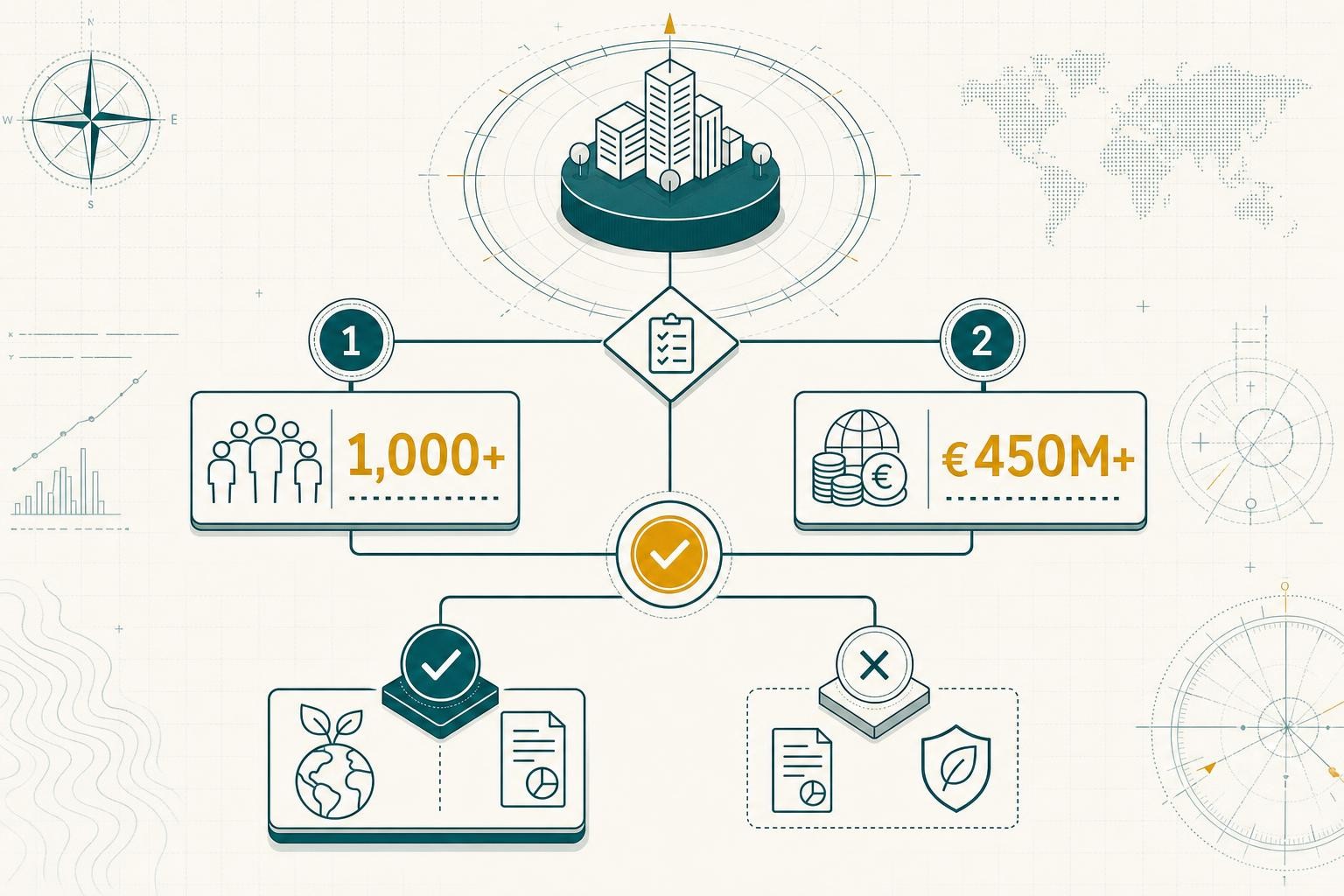
If you have been waiting for the dust to settle before asking "are we actually in scope?", this is the post. The Omnibus I simplification is now complete, and the answer for most companies has changed dramatically. One summary of the finished package estimates the reporting population fell from about 46,000 undertakings to about 4,800 per CoreFiling. This guide walks through the scope test in the order you should actually run it.
The headline rule: both thresholds, not either
For financial years beginning on or after 1 January 2027, an undertaking, or a group on a consolidated basis, is in the main scope only if it exceeds both 1,000 employees (average over the year) and EUR 450 million net turnover per London Reporting Academy's scope guide. The word is "and". The old balance-sheet-total test is gone, and the CoreFiling summary confirms CSRD now applies only to undertakings meeting both thresholds for two years or more.
Equality does not count as exceeding a threshold, and the exact test is set in national law. Always confirm the wording in your Member State's transposition before relying on a borderline result.
Step 1: Decide which test applies, entity or group
The individual test (Article 19a of the Accounting Directive) and the consolidated test (Article 29a) are separate analyses. A small standalone parent can still be caught under the consolidated test if the group as a whole exceeds both thresholds as the same guide notes. Run both, and run them for every EU entity, because a subsidiary may be covered by its parent's consolidated report but the exemption is not automatic: national conditions apply.
Step 2: Count correctly
Employees are an average over the financial year, not a snapshot on the balance sheet date. Turnover is net turnover. Two practical consequences follow. First, seasonal or agency-heavy workforces need a defined counting method documented in advance. Second, the "balance sheet date" language fixes the point at which you test, it is not a third criterion.
Step 3: Apply the transition rules
The new thresholds apply from FY2027. For FY2024 to FY2026 the original first-wave route still applies, and for FY2025 and FY2026 Member States may exempt entities below the new thresholds. That exemption is a national option, not something a company can elect for itself. This is why national transposition matters: Omnibus I (Directive (EU) 2026/470) entered into force on 18 March 2026, and Member States must transpose the relevant articles by 19 March 2027, according to the London Reporting Academy guide. Check your own date against our wave-by-wave timeline.
| Question | Rule |
|---|---|
| Employee threshold | More than 1,000 (annual average) |
| Turnover threshold | More than EUR 450m net turnover |
| How combined | Both must be exceeded |
| Balance sheet total | No longer a test |
| Level | Entity (Art. 19a) and consolidated (Art. 29a) tested separately |
| Listed SMEs | Removed from the mandatory regime |
Step 4: Check the special cases
Listed companies under the Transparency Directive are tested against the same thresholds, and listed SMEs are removed from the mandatory regime. Credit institutions and insurers follow the same reduced scope where the conditions are met. A narrow financial holding option lets a qualifying parent omit consolidated sustainability information if its subsidiaries' business models are independent, but it is not a general investment-group exemption. Non-EU groups face a separate regime: see our guide to Article 40a.
Step 5: Handle M&A and boundary changes
Acquired or merged undertakings can be deferred to the following period, and leavers excluded from the start of the current period, provided significant events are disclosed under ESRS 1 paragraphs 74 and 75. This is boundary relief, not a finding that the entity was never in scope.
What to do if you are now out of scope
Falling out of the mandatory regime does not end the data requests. Banks, customers and investors still ask. The Voluntary Standard, which replaces VSME for companies with up to 1,000 employees, is the proportionate answer; see our VSME guide and the explainer on the value chain cap that limits what large reporters can demand.
What to do if you are in scope
Start a gap analysis now. Our Wave 2 playbook and data collection guide cover the preparation steps, and the revised ESRS apply to financial years beginning on or after 1 January 2027.
Do I need to exceed both thresholds?
Yes. Under the Omnibus I rules an undertaking or group must exceed both 1,000 employees and EUR 450 million net turnover.
Is the balance sheet total still a criterion?
No. The balance-sheet test was removed.
Can a subsidiary rely on its parent's report?
Possibly, but the exemption is not automatic and depends on statutory and national conditions.
Can my company opt out for FY2025 or FY2026 if it is below the new thresholds?
Only if your Member State has exercised the national option to exempt such entities. It is not a company election.
What replaces VSME for smaller companies?
A Voluntary Standard targeting undertakings with up to 1,000 employees.
This article is general information, not legal advice. Confirm thresholds against your national transposition.
Related reading
The EU Data Centre Rating Scheme and CSRD: Turning PUE and WUE Labels into ESRS E1 and E3 Evidence
The Commission has adopted a mandatory A-to-G rating scheme for larger data centres. It is not an ESRS metric, but the data behind it overlaps heavily with ESRS E1 and E3. Here is how to reuse it without conflating the two.
EU Taxonomy Disclosures Review: What the Platform's Two-Tier OpEx KPI Proposal Means for CSRD Reporters
The EU Platform on Sustainable Finance has recommended a two-tier OpEx KPI and the end of the weighted-average group KPI. These are recommendations, not law, but they show where Taxonomy reporting is heading. Here is what to do now and what to keep flexible.

How to Structure a CSRD Sustainability Statement: A Design Guide for ESRS 1 (2026)
ESRS 1 (2026) gives preparers real structural choices for the first time. This guide covers where the statement lives, the new options in paragraphs 103-111, cross-referencing rules, connectivity, and a recommended skeleton you can use.