ESRS E5 Circular Economy: A Plain-English Guide to Resource Use Disclosure Under CSRD
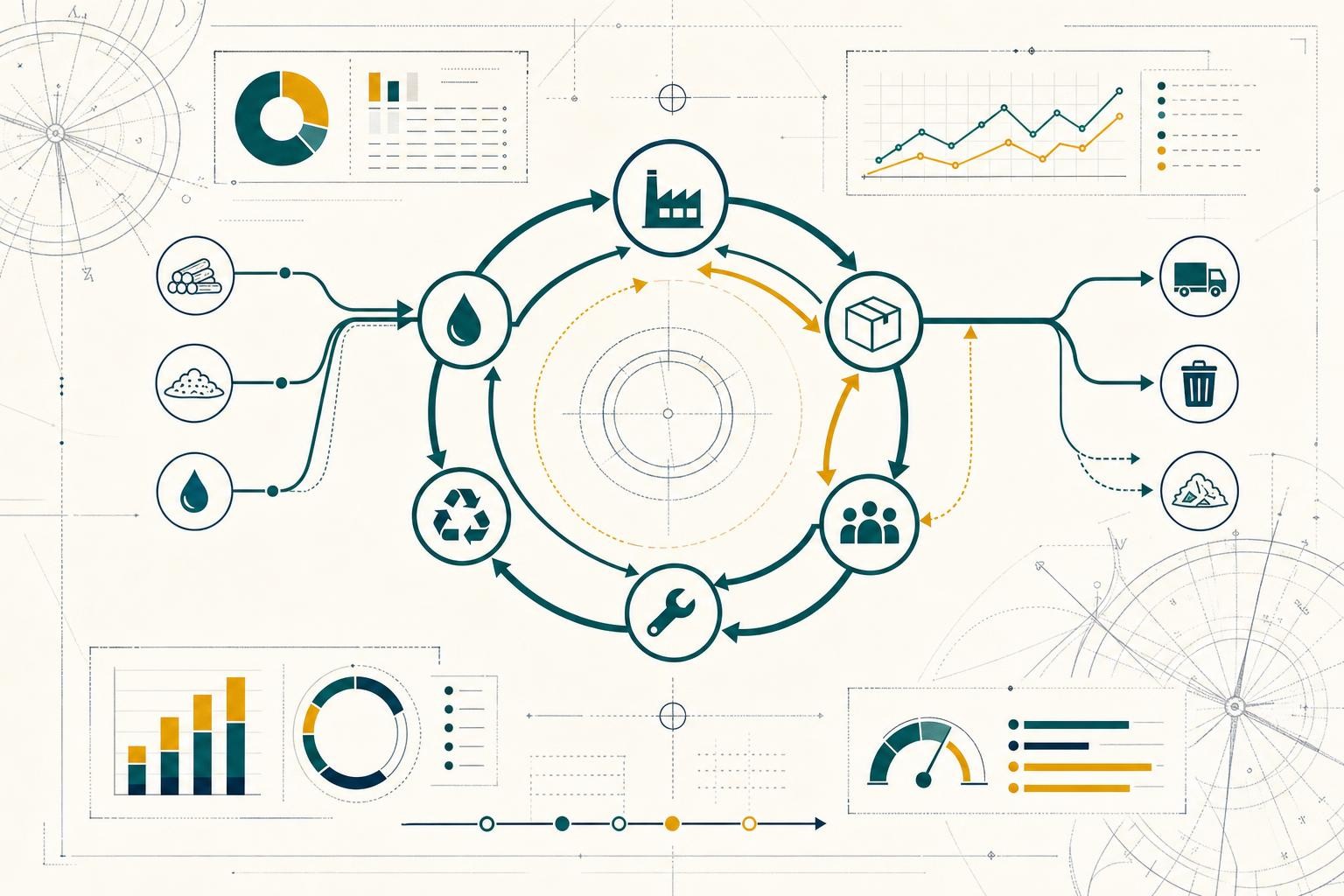
Most sustainability managers know ESRS E1 is the heavy lift - GHG inventories, transition plans, Scope 3. ESRS E5 tends to get less attention. That's a mistake, especially for manufacturers, consumer goods companies, and anyone with significant packaging or material inputs. E5 is where the EU's circular economy agenda lands in your sustainability statement, and the data it asks for lives in places most ESG teams have never looked: bills of materials, procurement systems, and waste contractor manifests.
This guide walks through what ESRS E5 actually requires, how the disclosure logic works, which metrics matter, where to find the underlying data, and what the simplified ESRS - adopted by the European Commission on 3 July 2026 - changed.
What ESRS E5 covers - and why it exists
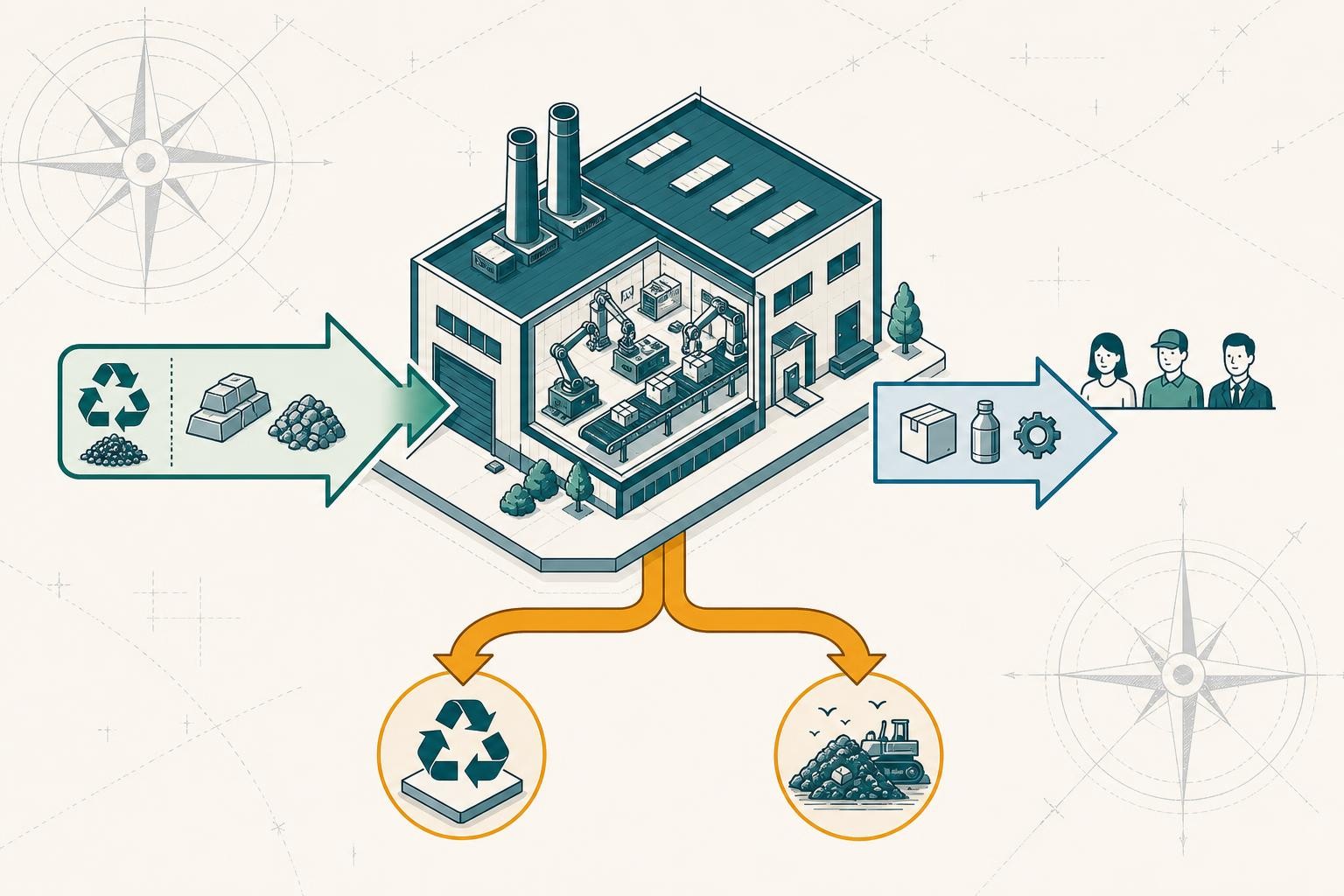
ESRS E5 is the topical environmental standard on Resource Use and Circular Economy. Its purpose is to make visible the physical flows of materials through a company: what comes in, what goes out as product, and what leaves as waste.
The standard relies on the identification of the physical flows of resources, materials and products used and generated by the undertaking - moving the economy away from a "take-make-waste" linear model toward a circular economic system.
The policy backdrop matters. Circular economy is a key pillar of the European Clean Industrial Deal (2025), which sets the EU's ambition to become a global leader in circular economy practices by 2030. The macro numbers show why urgency is warranted: the EU's circular material use rate (CMUR) reached only 12.2% in 2024 - its highest level ever, but still less than half the 2030 target of 23.2%. Secondary materials accounted for 12.2% of total material use in 2024, and this slow progress, along with projected increased material demand, implies that the EU is currently not on track to double the circular material use rate by 2030.
For companies, that gap is both a regulatory signal and a business risk. ESRS E5 offers clear business advantages: cost reduction from lower material use and waste treatment, innovation through circular products and services such as leasing, resale, and refurbishment, and risk management by reducing exposure to volatile commodity prices.
The materiality gate: does E5 apply to you?
ESRS E5 is a topical standard, which means it only applies in full if resource use and circular economy is material under your double materiality assessment (DMA). You do not have to report E5 disclosures simply because you are in CSRD scope.
The sustainability statement shall include information in relation to ESRS E5 if this topic relates to material impacts, risks, and opportunities. In practice, E5 applies to companies where circular economy topics are material per their DMA - this typically means companies with significant product waste or packaging obligations, manufacturers with material waste streams or resource-intensive processes, retailers handling high volumes of single-use packaging, and companies with take-back or end-of-life product responsibilities.
One important nuance: materiality applies sub-topic by sub-topic. The revised ESRS structures E5 more clearly around sub-topics - resource inputs, resource outputs (products and services), and resource outputs (waste) - with the materiality assessment applying separately to each sub-topic. This prevents over-reporting and helps companies focus on KPIs where they are most relevant financially and environmentally.
If your DMA concludes that only one sub-topic is material — say, waste but not inflows — you report in depth on that sub-topic and can provide a brief explanation for the others. Document the materiality justification clearly at sub-topic level; auditors will ask.
E5-1 to E5-5: the disclosure logic in plain English
ESRS E5 follows the same Policies -> Actions -> Targets -> Metrics structure used across all topical ESRS standards. Here is what each disclosure requirement asks for.
E5-1 - Policies
Describe your formal policies on resource use and circular economy. If circularity or eco-design principles are integrated into your key products and services, explain how. In practice, this means describing formal policies that guide how resources are sourced, used, and designed for reuse - for example, including eco-design standards in product development, supplier requirements, or procurement criteria.
Policies do not need to be standalone documents. The policies described under this disclosure requirement may be integrated in broader environmental or sustainability policies covering different sub-topics.
E5-2 - Actions and resources allocated
Disclose the concrete actions taken or planned to implement your policies, and the financial and operational resources allocated to them. This means describing the key actions taken during the reporting year and planned for the future, including their scope and timeframe; the expected outcomes and how they contribute to the related policy; and the financial resources (operational and/or capital expenditure) allocated, including where these amounts appear in the financial statements.
E5-3 - Targets
Set measurable, time-bound targets linked to your material resource and waste topics. The undertaking shall specify to which layer of the waste hierarchy each target relates. Targets must be quantifiable and time-bound, and should relate directly to the company's material resource and waste topics - for example, reducing total waste generated by a set percentage by a certain year, or increasing the share of secondary or recycled materials in production.
E5-4 - Resource inflows
This is the first quantitative disclosure. The quantitative data focus on material inputs: total weight of key materials and the share of critical, secondary, or sustainably sourced inputs.
Under the revised ESRS, the concept of "key materials" is now formally defined. The term "key material" is now defined as a concept in Annex II, and revised E5-4 requires companies to disclose the key materials used in their operations, replacing the previous breakdown between biological and technical material categories. Secondary resources must be disclosed as total weight or percentage of total inflow.
The circular material use rate (or recycled input share) is the headline metric here: what proportion of your material inputs comes from recycled or secondary sources rather than virgin extraction?
E5-5 - Resource outflows
Resource outflows cover two things: what your products look like at end of life, and what waste your operations generate.
Products and services: Material outputs include product durability, reparability, rate of recyclable materials in key products and packaging, and rate of recycled materials in key products. The standard uses a designed recyclability rate formula: the total weight of recyclable materials incorporated in a product divided by the total weight of the product.
Waste: Detailed breakdown of waste streams, hazardous vs. non-hazardous, and waste management methods is required. This is often the most data-intensive E5 disclosure. You must distinguish between waste diverted from disposal (reuse, recycling, composting, energy recovery) and waste directed to disposal (landfill, incineration without energy recovery). Hazardous and radioactive waste must be broken out separately.
What happened to E5-6 (financial effects)?
The original ESRS E5 included a sixth disclosure requirement - E5-6 - covering anticipated financial effects from resource-use risks and opportunities. The disclosure requirements related to anticipated financial effects have been removed from the topical standards, including ESRS E5, as they are expected to be addressed under the provisions in ESRS 2. In other words, financial effects from circular economy risks and opportunities are still disclosable - they just move to the cross-cutting ESRS 2 framework rather than sitting in a standalone E5 section.
The key metrics and where the data lives
What makes ESRS E5 complex is that it requires organisations to connect data across procurement, production, and waste-management systems. The table below maps each metric to its likely data source.
| Metric | Disclosure | Where the data lives | Common challenge |
|---|---|---|---|
| Total weight of key materials (by material) | E5-4 | Procurement / ERP / bill of materials (BOM) | BOM data often lacks recycled-content flags from suppliers |
| Recycled / secondary input share (%) | E5-4 | Supplier declarations, procurement system | Requires supplier-level data; value chain cap limits what you can demand |
| Critical raw materials used | E5-4 | BOM cross-referenced against EU CRM list | CRM list updated periodically — check the 2023 revision |
| Designed recyclability rate (%) | E5-5 | Product design / R&D / LCA data | Needs product-level calculation; not available from ERP alone |
| Total waste generated (tonnes) | E5-5 | Waste contractor manifests, site environmental records | Multi-site aggregation; ensure consistent European Waste Catalogue codes |
| Hazardous vs. non-hazardous waste split | E5-5 | Waste manifests, environmental permits | Classification must follow EU Waste Framework Directive definitions |
| Waste diverted from disposal (%) | E5-5 | Waste contractor certificates (recycling, composting, energy recovery) | Need processor certificates, not just contractor invoices |
| Waste directed to disposal (landfill / incineration without recovery) | E5-5 | Waste contractor manifests | Incineration with energy recovery counts as diversion, not disposal |
This means tracing information across procurement, operations, and waste management systems to build a single, consistent record of how materials enter and leave the organisation - and confirming that supporting evidence exists, such as supplier declarations, manifests, or processor certificates.
What the simplified ESRS (2026) changed for E5
On 3 July 2026, the European Commission adopted the final delegated act containing the simplified ESRS (2026). The European Commission adopted the final delegated act on 3 July 2026. This is one of the final steps of the Omnibus package intended to simplify EU sustainability reporting rules. Entities subject to CSRD must apply ESRS (2026) for financial years beginning on or after 1 January 2027.
The headline change across all standards: the revised ESRS cut mandatory datapoints by approximately 61% compared to the original 2023 set. EFRAG pointed out that the revised standards are overall shorter, clearer, and easier to apply. They contain a 61% cut in required data points and a full elimination of voluntary disclosures, which have been moved to a separate guidance document.
For E5 specifically, the key changes are:
- E5-6 removed - anticipated financial effects move to ESRS 2 (see above).
- "Key materials" concept introduced - replaces the old biological/technical material split with a defined concept that companies apply to their own context.
- Several waste and material flow metrics made conditional - applicable only when material per the DMA, rather than mandatory for all reporters.
- Product design and end-of-life disclosures simplified - the designed recyclability rate formula is retained, but surrounding requirements are leaner.
- New transparency requirement on waste with unknown final destination - a small but practically important addition.
The Omnibus I Directive introduced significant simplifications across all ESRS standards, including ESRS E5. Mandatory data points were reduced substantially, and many previously required disclosures became conditional or optional.
Who this affects and when:
Wave 1 companies (large listed entities and other PIEs already under NFRD) continue to report under the current ESRS, plus the July 2025 quick-fix reliefs, for 2024 to 2026, and are expected to switch to the amended ESRS from 2027 onward. Wave 2 companies (other large EU undertakings) now first report for financial year 2027, which is likely to be directly under the amended ESRS rather than the original 2023 set.
For FY2026, companies already reporting have three options: apply ESRS (2023) as amended by the Quick Fix; apply ESRS (2023) with selected ESRS (2026) reliefs (e.g. the top-down DMA approach); or apply ESRS (2026) in full. Whichever you choose, you must clearly disclose which version you applied.
The E5 materiality decision tool
Not sure whether E5 is material for your company - and which sub-topics to report in depth? Use this quick decision tool to map your situation.
A practical get-ready checklist
Whether you are a Wave 1 reporter preparing for FY2027 under the simplified ESRS, or a Wave 2 company approaching your first report, the preparation steps are the same - just the timeline differs.
Assess resource inflows, resource outflows (products), and waste separately. Document the reasoning for each conclusion. If any sub-topic is material, you report E5-1 through E5-5 for that sub-topic.
Pull your bill of materials (BOM) or procurement spend data. Identify the materials that are significant by weight or value. Cross-check against the EU Critical Raw Materials list. This is the foundation for E5-4.
Request supplier declarations for recycled or secondary content in key materials. Note: the value chain cap under the revised CSRD limits what you can demand from suppliers with fewer than 1,000 employees — use the VSME voluntary standard as the ceiling for requests.
Gather waste contractor manifests for all sites. Ensure waste is classified using European Waste Catalogue (EWC) codes. Separate hazardous from non-hazardous. Confirm you have processor certificates (not just invoices) for waste claimed as diverted from disposal.
Work with product design and R&D teams to calculate the designed recyclability rate for key products. If you have Life Cycle Assessment (LCA) data, use it — LCAs provide the ISO 14040/44-aligned evidence that auditors and investors trust.
Targets must specify which layer of the waste hierarchy they relate to (prevention, reuse, recycling, recovery, disposal). Prioritise absolute targets over intensity-based ones where possible.
Check how your E5 disclosures interact with the Packaging and Packaging Waste Regulation (PPWR), the Ecodesign for Sustainable Products Regulation (ESPR), and any Extended Producer Responsibility (EPR) obligations. These rules share data requirements with E5.
The bottom line
ESRS E5 is not a box-ticking exercise for companies with physical products. It asks for verified, auditable data on how materials flow through your business - data that most companies have never aggregated in one place. The simplified ESRS (2026) reduced the mandatory datapoint count significantly, but the core logic - inflows, outflows, waste, policies, actions, targets - is intact.
The companies that will find E5 manageable are those that start early: mapping key materials, fixing waste data infrastructure, and engaging suppliers on recycled content before the reporting deadline arrives.
The EU's 2020 Circular Economy Action Plan aims to double the EU's circular material use rate to 23.2% by 2030 - from a 2024 baseline of just 12.2%. That gap is the policy context behind every E5 disclosure requirement. Your report is, in part, the EU's mechanism for tracking whether companies are closing it.
Related reading

How to Structure a CSRD Sustainability Statement: A Design Guide for ESRS 1 (2026)
ESRS 1 (2026) gives preparers real structural choices for the first time. This guide covers where the statement lives, the new options in paragraphs 103-111, cross-referencing rules, connectivity, and a recommended skeleton you can use.

EU Pay Transparency Directive Meets ESRS S1: Why 2026 Is the Year Your Pay Data Gets Checked Twice
2026 is the reference year for both the EU Pay Transparency Directive and ESRS S1 pay gap metrics. If your two numbers differ and you can't explain why, that's a credibility problem in front of regulators, assurance providers, and works councils simultaneously.
"Undue Cost or Effort" Under ESRS 1 (2026): What Actually Changed for Value Chain Data
The revised ESRS 1 (adopted 3 July 2026) rewrites value chain data rules. Here's what changed, what the proportionality mechanism actually means, and how to document it for assurance.