ESRS E2 Pollution: A Practitioner's Guide to Disclosure Under the Revised CSRD

Pollution data has lived in environmental compliance silos for decades. Permit returns, E-PRTR submissions, REACH declarations - the numbers exist, but they were never designed to land in an investor-grade sustainability statement. ESRS E2 changes that. For companies that find pollution material through their double materiality assessment, the standard demands a coherent, auditable narrative that runs from policy to quantitative emissions to anticipated financial effects.
This guide walks through every layer of that requirement - what the standard covers, how to determine whether it applies to you at all, what each of the six disclosure requirements actually asks for, where the data comes from, and how E2 connects to the rest of the ESRS framework.
The regulatory moment: Omnibus I and the revised ESRS
Before diving into E2 itself, the timeline matters.
On 3 July 2026, the European Commission formally adopted the Delegated Act revising the ESRS as part of the Omnibus I simplification package. The revised standards - ESRS (2026) - replace Annexes I and II of Delegated Regulation (EU) 2023/2772 in full. They reduce mandatory datapoints by 61% compared with the first-generation standards, and total datapoints (including voluntary) by more than 70%.
The revised ESRS apply from financial year 2027, with voluntary early adoption available for FY2026. The act is currently in the two-month parliamentary scrutiny period before entering into force.
Scope has also contracted sharply. Under the Omnibus I framework, CSRD reporting obligations apply only to EU undertakings with more than 1,000 employees and net annual turnover exceeding €450 million. Wave 1 large PIEs (already reporting under the NFRD) are unaffected. Wave 2 companies - non-NFRD companies meeting the 1,000-employee and €450 million turnover thresholds - will first report in 2028, covering financial year 2027. Most former Wave 3 listed SMEs are now fully out of mandatory scope.
For E2 specifically, the Omnibus revision reinforces a principle that was always present but is now more explicit: materiality is the gatekeeper. Fewer companies are in scope, and those that are report only what their double materiality assessment (DMA) identifies as genuinely material.
What ESRS E2 covers
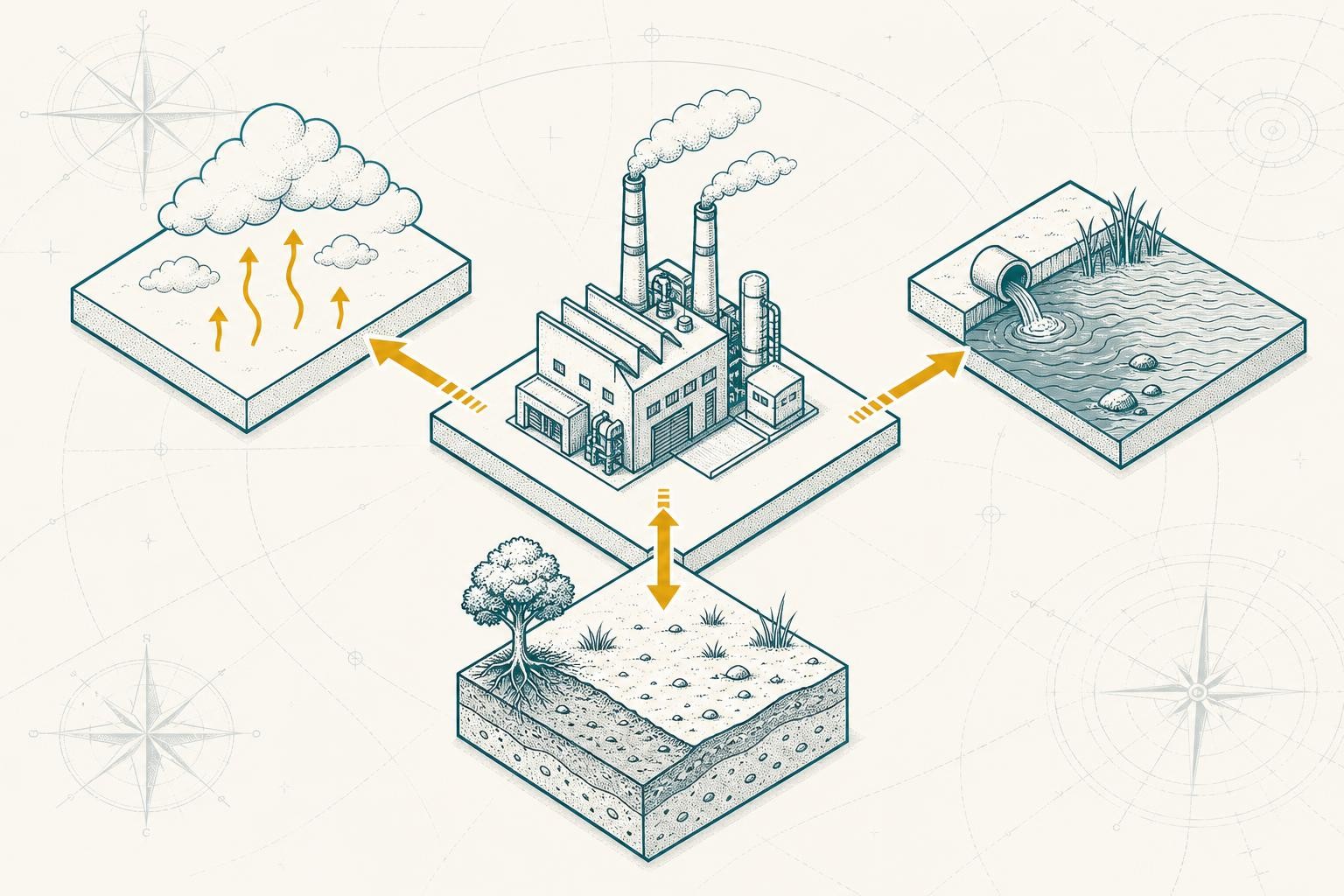
ESRS E2 is the pollution standard within the CSRD's environmental pillar. It addresses a company's impacts, risks and opportunities (IROs) related to pollution across its own operations and, where material, its value chain.
The standard organises its subject matter into four sub-topics:
- Pollution of air - emissions of non-GHG pollutants to the atmosphere (particulates, NOx, SOx, VOCs, heavy metals, and others listed in the E-PRTR Annex II)
- Pollution of water - releases to freshwater and seawater, including via wastewater discharge and accidental spills
- Pollution of soil - contamination from operational activities, deposits, and incidents
- Microplastics - primary microplastics generated or used by the company, or released during product use or end-of-life
- Substances of concern (SoC) and substances of very high concern (SVHC) - hazardous chemicals used, produced, or present in products
One boundary worth noting immediately: GHG emissions are not part of E2. They belong to ESRS E1 (Climate Change). E2 covers the non-GHG pollution universe - the NOx, heavy metals, persistent organic pollutants, and chemical substances that sit outside the climate accounting boundary.
The double materiality gate: does E2 apply to you?
ESRS E2 is not mandatory for every CSRD reporter. The standard applies only where pollution is identified as a material topic through the company's DMA. This is the single most important sentence in the standard, and it has practical consequences.
Impact materiality asks: does the company cause, or is it connected to, significant actual or potential harm to people or the environment through pollution? A chemical manufacturer releasing heavy metals to a river, or a food producer discharging nitrogen to a water-stressed catchment, will almost certainly clear this bar.
Financial materiality asks: do pollution-related risks or opportunities affect the company's financial position, performance, or cost of capital? Regulatory risk (tightening emission limits, permit revocations), litigation exposure, remediation liabilities, and the cost of transitioning away from restricted substances all count here.
Either test, independently, triggers E2 disclosure. Both together make the case stronger.
The DMA is the gatekeeper — not the sector, not the size of the company. A large industrial group might scope E2 out if its pollution footprint is genuinely negligible and no financial risks are identified. A mid-sized specialty chemicals company will almost certainly scope it in. The standard requires you to document the reasoning either way.
Sectors that typically scope E2 in: industrial manufacturing, chemicals, mining and metals, energy generation, food and beverage processing, construction materials, transport infrastructure, and waste management. Sectors that often scope E2 out: pure-play financial services, software, and professional services - though value-chain exposures (financed emissions, supplier chemicals) may still raise material financial risks worth disclosing under ESRS 2.
The revised ESRS (2026) reinforces a top-down DMA approach: conclude materiality at the topic level first, then drill into sub-topics and individual disclosure requirements only for what passes. This means a company that finds air pollution material but soil pollution immaterial can limit its E2-4 disclosure to air - provided the DMA is documented and defensible.
The six disclosure requirements, explained
The standard follows the same policy-action-target-metric-financial-effect architecture used across the topical ESRS. Here is what each requirement actually asks for.
E2-1 - Policies related to pollution
Describe the policies the company has adopted to manage material pollution-related impacts, risks and opportunities. This is qualitative. The standard expects you to explain the scope of the policy (which operations, which pollutants), how it connects to the company's broader environmental strategy, and whether it references specific regulatory frameworks such as the Industrial Emissions Directive or the EU Zero Pollution Action Plan.
A common gap here: many companies have a general environmental policy that mentions pollution in passing. E2-1 expects something more specific - a policy that names the material sub-topics identified in the DMA and sets out how they are governed.
E2-2 - Actions and resources related to pollution
Disclose the concrete actions taken or planned to implement the pollution policies, and the financial and human resources allocated to them. This includes pollution prevention measures (process changes, substitution of hazardous substances), pollution control measures (end-of-pipe treatment, containment), and remediation activities for legacy contamination.
The resources dimension matters for assurance purposes. Vague references to "ongoing investment in environmental controls" are not sufficient; the standard expects a link between the actions described and the capital or operating expenditure committed.
E2-3 - Targets related to pollution
Set out the time-bound, measurable targets the company has adopted for reducing material pollution impacts. Targets should specify the baseline year, the target year, the metric used (e.g. tonnes of NOx per unit of production), and the methodology for tracking progress.
Not every company will have formal pollution reduction targets at the point of first reporting. The standard does not require targets to exist - but if they do not, that absence must be explained.
E2-4 - Pollution of air, water and soil
This is the quantitative core of the standard. Companies must disclose the amounts of material pollutant emissions to air, water and soil during the reporting period, including releases from environmental accidents.
The pollutant list aligns with Annex II of the E-PRTR Regulation (Regulation (EC) No 166/2006), which covers substances ranging from heavy metals and persistent organic pollutants to nitrogen compounds and particulate matter. Note that the E-PRTR framework is being superseded by the Industrial Emissions Portal Regulation (IEPR, Regulation (EU) 2024/1244), which entered into force in May 2024 and applies from 1 January 2028 - so for FY2027 reporting, the E-PRTR list remains the reference.
Microplastics are also reported here: companies that intentionally produce microplastics, or whose products release them during use or end-of-life, must disclose the quantities.
A few technical points that trip up first-time reporters:
- Consolidation boundary: emissions are reported on a financial or operational control basis, covering facilities where the applicable E-PRTR threshold is exceeded
- GHG exclusion: CO₂, CH₄, N₂O and other GHGs go to E1, not E2
- Disaggregation: where pollution impacts are geographically concentrated, the standard expects site-level or regional breakdowns
- Methodology disclosure: measurement approach, uncertainty ranges, and data sources must be described alongside the numbers
E2-5 - Substances of concern and substances of very high concern
This disclosure connects ESRS E2 directly to EU chemicals regulation.
Substances of Very High Concern (SVHCs) are defined under Article 59(1) of REACH - carcinogens, mutagens, reproductive toxins (CMRs), and substances that are persistent, bioaccumulative and toxic (PBT) or very persistent and very bioaccumulative (vPvB). The ECHA Candidate List is the authoritative reference. Manufacturers, importers or users of articles that contain SVHCs must disclose the names of substances present above 0.1% weight-by-weight, in line with Article 33 of REACH.
Substances of Concern (SoC) is a broader category aligned with the EU Chemicals Strategy for Sustainability. Under the revised ESRS (2026), full SoC mass reporting - volumes produced, used, distributed, imported and exported - is scoped primarily to companies in the chemicals sector. Non-chemical companies still disclose SVHCs, but the broader SoC reporting universe is no longer their burden. This is one of the clearer simplifications from the Omnibus revision.
SVHC data must be grouped by hazard class under the CLP Regulation, avoiding double-counting across categories. The 0.1% by weight threshold mirrors the REACH SVHC notification trigger, which means the data should already be tracked through REACH-driven supplier declarations and SCIP database submissions. The work in E2-5 is consolidating that existing data into a single disclosure, not collecting it from scratch.
E2-6 - Anticipated financial effects
The final disclosure requirement carries pollution risk into the financial statement narrative. Companies must provide qualitative and, where feasible, quantitative information on the expected financial effects of pollution-related risks and opportunities over the short, medium and long term.
This covers both risks (regulatory tightening, remediation costs, stranded assets, litigation) and opportunities (cleaner production processes, green chemistry, avoided costs from pollution prevention). The revised ESRS (2026) extends transitional relief for anticipated financial effects, acknowledging that quantification is genuinely difficult in the first reporting cycles.
The standard allows disclosure of an order of magnitude or indicative ranges where precise figures are not available - but the direction of travel, the time horizon, and the key assumptions must be explained.
Where the numbers come from: the data challenge
Pollution data lives in environmental compliance silos, not in sustainability or finance teams - and the first wave of CSRD reporters has found that translating operational permit data into investor-grade disclosures is harder than it looks.
Here is the typical data landscape for an industrial company preparing E2:
| Disclosure Requirement | Primary Data Source | Supporting Reference |
|---|---|---|
| E2-4 (Air emissions) | EHS monitoring systems, continuous emission monitoring (CEM), stack tests | E-PRTR / IEPR submissions, IED permit returns |
| E2-4 (Water emissions) | Effluent monitoring data, wastewater discharge permits | National PRTR reports, water authority returns |
| E2-4 (Soil) | Site investigation reports, contamination registers | Regulatory remediation orders, environmental liability assessments |
| E2-4 (Microplastics) | Process mass balance, product formulation data | REACH restriction on synthetic polymer microparticles (Reg. 2023/2055) |
| E2-5 (SVHC) | REACH Article 33 supplier declarations, SCIP database | ECHA Candidate List, CLP hazard classifications |
| E2-5 (SoC — chemicals sector) | Chemical inventory systems, procurement data | CLP Regulation Annex II, EU Chemicals Strategy |
| E2-6 (Financial effects) | Risk register, insurance valuations, remediation cost estimates | Regulatory impact assessments, scenario analysis |
EFRAG explicitly references the E-PRTR and the Industrial Emissions Portal as key inputs for determining which pollutants are material and for sourcing the underlying emission data. For companies whose installations already submit to national PRTRs, that data is the natural starting point for E2-4 - but the consolidation boundary for ESRS may differ from the regulatory reporting boundary, which creates reconciliation work.
The cross-standard connections also matter:
- ESRS E1 (Climate): GHG emissions are excluded from E2 but must be disclosed under E1. The boundary logic should be consistent - the same operational control or financial control approach should apply to both standards.
- ESRS E3 (Water and Marine Resources): Emissions to water are reported under E2-4, but water consumption and water stress context belong to E3. Companies with significant water-related pollution (nitrogen, phosphorus, heavy metals to rivers) will need to coordinate disclosures across both standards to avoid gaps or double-counting.
- ESRS E5 (Circular Economy): Substances of concern in products connect directly to E5's product design and end-of-life disclosures. A company phasing out SVHCs from its product portfolio will have relevant disclosures in both E2-5 and E5.
Is E2 material for your company? Use this decision tool
Get-ready checklist for EHS and reporting teams
The following checklist is structured around the sequence of work most teams will need to complete before their first E2 disclosure.
Phase 1: Materiality and scoping
- Run or update the DMA to assess pollution at the topic level, then sub-topic level (air, water, soil, microplastics, SoC/SVHC)
- Document the rationale for scoping E2 in or out - the DMA file is the audit trail
- Identify which facilities and value-chain segments are in scope for E2 disclosures
- Confirm the consolidation boundary (financial control vs. operational control) and align it with the E1 boundary
Phase 2: Policy and governance
- Review existing environmental policies for E2-1 adequacy - do they name the material sub-topics?
- Map current pollution-related actions and expenditures for E2-2
- Identify whether formal pollution reduction targets exist; if not, decide whether to set them for E2-3
Phase 3: Data collection
- Pull existing E-PRTR / national PRTR submissions and map them to the E2-4 pollutant list
- Reconcile permit monitoring data with ESRS consolidation boundaries
- Compile REACH Article 33 SVHC declarations from suppliers; cross-reference with the ECHA Candidate List
- For chemicals-sector companies: build or validate the SoC mass balance (procured, manufactured, placed on market, emitted)
- Identify microplastics sources in operations and products
Phase 4: Financial effects
- Map pollution-related items in the risk register to E2-6 categories (regulatory, litigation, remediation, transition)
- Agree with finance on the time horizons (short/medium/long term) and quantification approach
- Document assumptions and ranges where precise figures are not available
Phase 5: Assurance readiness
- Ensure data trails are auditable: measurement methodology, uncertainty ranges, and data sources documented for each E2-4 metric
- Cross-check E2 disclosures against E1, E3 and E5 for consistency and to avoid gaps or double-counting
If your installations already submit to national PRTRs, that data is your E2-4 starting point — but check the consolidation boundary. PRTR submissions cover individual regulated facilities; ESRS E2 requires consolidation across all facilities under financial or operational control where E-PRTR thresholds are exceeded. The gap between the two is where reconciliation work sits.
Frequently asked questions
Does ESRS E2 apply if we are not an industrial company?
E2 applies only where pollution is material following your DMA. Pure-play financial services, software and professional services companies often scope E2 out — but value-chain exposures (financed activities, supplier chemicals) may still create material financial risks that need to be addressed, at minimum under ESRS 2's general IRO disclosures. Document the DMA rationale clearly either way.
Are GHG emissions reported under E2?
No. Greenhouse gas emissions (CO₂, CH₄, N₂O, F-gases, etc.) are disclosed under ESRS E1 (Climate Change). ESRS E2 covers non-GHG pollutants — NOx, SOx, particulates, heavy metals, persistent organic pollutants, nitrogen and phosphorus to water, and so on. The boundary should be consistent with the E1 consolidation approach.
What is the difference between SoC and SVHC?
Substances of Very High Concern (SVHCs) are a specific legal category under REACH — carcinogens, mutagens, reproductive toxins, and PBT/vPvB substances on the ECHA Candidate List. Substances of Concern (SoC) is a broader category aligned with the EU Chemicals Strategy, covering a wider range of hazardous properties. Under the revised ESRS (2026), full SoC mass reporting is scoped primarily to the chemicals sector; non-chemical companies focus on SVHCs.
What is the 0.1% threshold in E2-5?
The 0.1% weight-by-weight threshold mirrors the REACH Article 33 SVHC notification trigger. If an article you manufacture, import or use contains an SVHC above this concentration, you must disclose the substance name. The data should already exist in your REACH compliance records and SCIP database submissions.
How does the Omnibus revision change E2 specifically?
The revised ESRS (2026) adopted on 3 July 2026 reinforces the materiality-first approach, narrows full SoC reporting to the chemicals sector, retains but clarifies microplastics disclosure, and extends transitional relief for quantifying anticipated financial effects (E2-6). The overall datapoint reduction of 61% applies across the ESRS framework; for E2, the practical effect is fewer mandatory checklist items and more focus on what is genuinely material.
When does E2 first apply?
The revised ESRS (2026) apply from financial year 2027, with voluntary early adoption for FY2026. Wave 1 large PIEs already reporting under the original ESRS are unaffected by the timing change. Wave 2 companies (>1,000 employees and >€450m turnover, non-NFRD) first report in 2028 for FY2027.
How does E2 connect to E3 (Water)?
Emissions to water are quantified under E2-4, but water consumption, water stress context, and water-related dependencies belong to ESRS E3. Companies with significant water-related pollution — nitrogen, phosphorus, heavy metals discharged to rivers — need to coordinate E2 and E3 disclosures carefully to avoid gaps or inconsistencies.
A note on structured data collection
The practical lesson from first-wave CSRD reporters is consistent: the data for E2 exists in most industrial companies, but it is scattered across EHS systems, permit files, REACH compliance records, and environmental incident logs. The challenge is not collection - it is consolidation, reconciliation, and documentation to audit-ready standard.
Starting that consolidation work now, before the FY2027 reporting cycle, gives teams time to identify gaps, align boundaries with E1 and E3, and build the methodology documentation that assurance providers will expect.
Related reading

Your Sustainability Statement and Your Packaging Are Now Legally Coupled: What EmpCo Means for CSRD Reporters
From 27 September 2026, EU consumer law reads your ESRS E1 data against your marketing claims. Here's what the EmpCo Directive bans, what it requires, and why your sustainability statement is now evidence.

The ESG Rating Black Box Just Got a Window: What Regulation 2024/3005 Means for Rated Companies
From 2 July 2026, EU Regulation 2024/3005 requires ESG rating providers to disclose their methodologies, materiality lens, and separate E, S and G scores. Here's what that means for IR and sustainability teams being rated.

ESAP European Single Access Point: What CSRD Reporters Need to Know Before 2028
ESAP goes live in July 2027. CSRD sustainability data follows in January 2028. Here's what the phased rollout means for your reporting process - and what to fix now.