ESRS vs ISSB vs GRI: The ESG Reporting Frameworks Compared (2026 Edition)

If you're a sustainability manager at a multinational right now, you're probably staring at three sets of requirements that each claim to be "the" framework for ESG disclosure. The EU wants ESRS under the CSRD. Investors and capital markets in 30-plus jurisdictions are moving toward ISSB. And your stakeholders, supply chain partners, and NGO audiences still speak GRI.
The good news: these frameworks were deliberately designed to talk to each other. The bad news: nobody handed you the translation guide. This article is that guide.
Why three frameworks, not one?
Each framework was built to serve a different master.
- ESRS (European Sustainability Reporting Standards) serves EU regulators and the CSRD's dual mandate: protect investors and hold companies accountable for their impacts on people and the planet.
- ISSB (IFRS S1 and S2) serves global capital markets - specifically, the information needs of investors making capital allocation decisions.
- GRI Standards serve the broadest audience: any stakeholder - communities, employees, civil society, governments - who wants to understand a company's real-world impacts.
These aren't competing products. They're different lenses on the same underlying data. Understanding which lens your primary audience uses is the first step to building a reporting architecture that doesn't duplicate work.
At a glance: the three frameworks compared
| Dimension | ESRS (EU CSRD) | ISSB (IFRS S1 & S2) | GRI Standards |
|---|---|---|---|
| Standard-setter | EFRAG (adopted by European Commission) | ISSB / IFRS Foundation | Global Sustainability Standards Board (GSSB) |
| Materiality model | Double materiality (impact + financial) | Financial materiality only | Impact materiality only |
| Primary audience | Investors, regulators, civil society | Investors / capital markets | All stakeholders (broad) |
| Mandatory or voluntary? | Mandatory for in-scope EU companies | Mandatory in 21+ jurisdictions; voluntary elsewhere | Voluntary globally (referenced in some mandates) |
| SASB content | Referenced as optional industry guidance | Folded into IFRS S1 industry-based guidance | Separate; GRI has own sector standards |
| TCFD status | Absorbed into ESRS E1 (climate) | Absorbed into IFRS S2 | Not directly incorporated |
| Scope of topics | Climate, pollution, water, biodiversity, circular economy, workforce, communities, consumers, governance | All sustainability-related risks & opportunities (S1); climate (S2) | 34 topic-specific standards across environment, social, governance |
ESRS: the mandatory EU baseline
ESRS is the reporting language of the CSRD. If your company is in scope - a large EU company, or a non-EU company with significant EU revenues - ESRS is not optional.
The defining feature of ESRS is double materiality: a topic must be disclosed if it is material from an impact perspective (your company affects people or the environment) or from a financial perspective (sustainability issues affect your company's cash flows, value, or cost of capital). Either test triggers disclosure; you don't need both.
The revised ESRS - currently in draft following EFRAG's December 2025 consultation - cuts mandatory datapoints by roughly 60-70% compared with the original set. The simplified version applies from FY2027, with voluntary early adoption possible for FY2026. One deliberate design choice in the revision: the simplified ESRS was drafted to enhance interoperability with ISSB standards, making the "report once, reuse" approach more achievable than ever.
ESRS is the anchor framework for any EU-headquartered multinational. Even if you also report to ISSB or GRI audiences, start your data architecture with ESRS — the interoperability mappings then let you derive the other outputs rather than building them separately.
ISSB: the global investor baseline
The ISSB published IFRS S1 (general sustainability-related financial disclosures) and IFRS S2 (climate-related disclosures) in June 2023. IFRS S2 absorbed the TCFD framework entirely; IFRS S1 incorporated SASB's industry-specific metrics as built-in guidance.
The ISSB's materiality lens is purely financial: disclose what a sophisticated investor would consider material to the company's enterprise value. Impacts on the world that don't feed back into financial risk or opportunity are, strictly speaking, out of scope - that's GRI's territory.
Adoption is accelerating fast. As of 1 January 2026, 21 jurisdictions had adopted ISSB standards on a voluntary or mandatory basis, with mandatory rules taking effect in Chile, Qatar, and Mexico at the start of 2026. Over 30 jurisdictions representing more than half of global GDP have taken steps toward adoption or use of the ISSB standards. For multinationals listed or operating in Asia-Pacific, the Americas, or the Middle East, ISSB compliance is increasingly a live obligation - not a future consideration.
GRI: the stakeholder-accountability standard
GRI Standards are used by over 14,000 organisations worldwide, and nine in ten companies that do sustainability reporting choose GRI. That ubiquity matters: GRI is the lingua franca of sustainability disclosure for NGOs, procurement teams, ESG rating agencies, and civil society.
GRI's materiality model is impact materiality - the mirror image of ISSB's financial focus. GRI asks: what are the most significant impacts of this organisation on the economy, environment, and people? The answer drives what gets disclosed.
GRI is voluntary globally, though some jurisdictions reference it in mandatory frameworks. Its real power is breadth: GRI's 34 topic-specific standards cover everything from emissions and water to human rights, anti-corruption, and tax transparency. For companies that need to communicate with a wide stakeholder universe - not just investors - GRI remains indispensable.
The interoperability picture: what the mappings actually let you do
This is where the practical value lies. All three standard-setters have invested heavily in interoperability, and the results are now published and usable.
ESRS ↔ ISSB
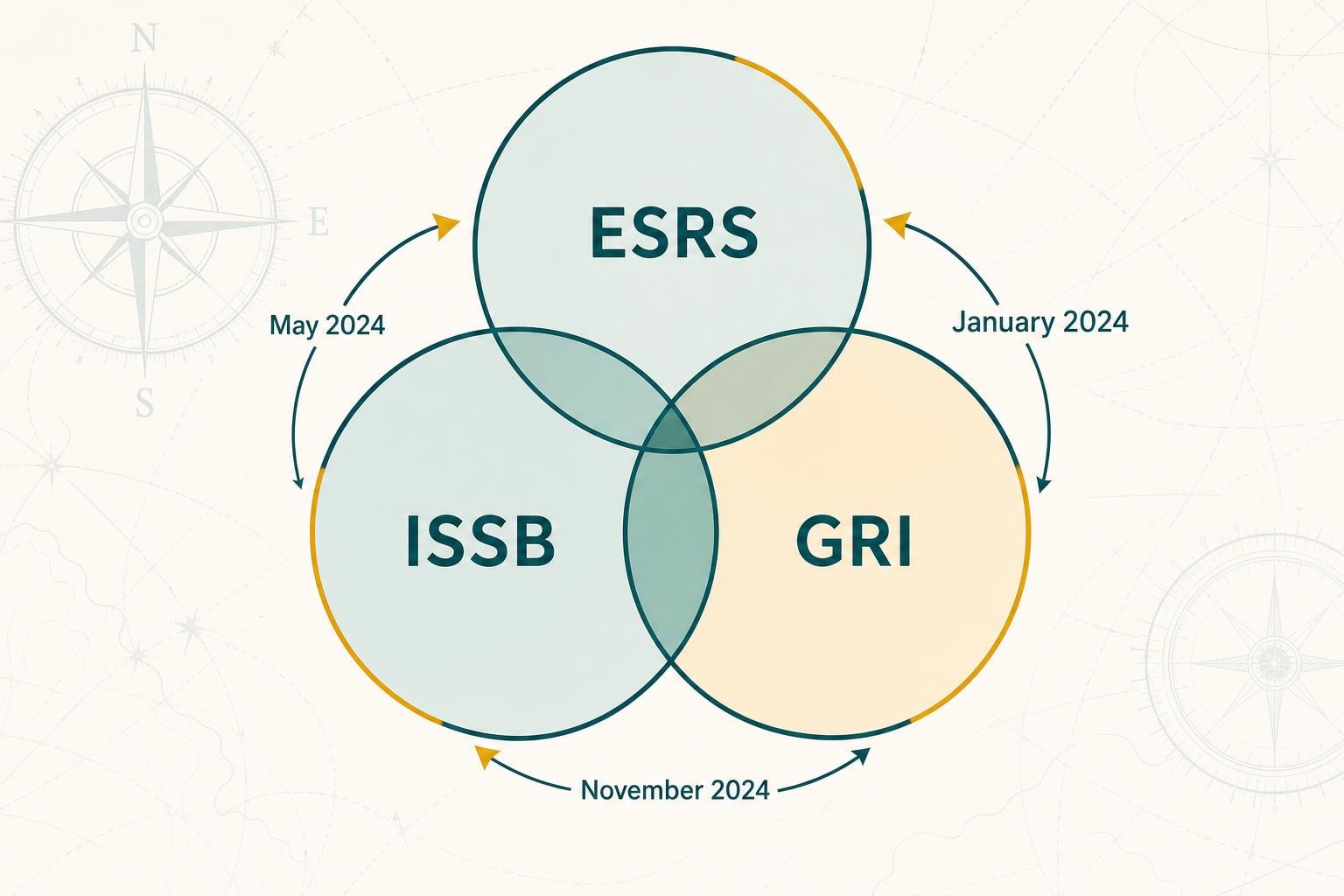
On 2 May 2024, EFRAG and the ISSB jointly published the "ESRS-ISSB Standards Interoperability Guidance," illustrating the high level of alignment between the two sets of standards. The guidance focuses primarily on climate (ESRS E1 vs IFRS S2) and shows that the two frameworks' climate disclosure requirements are largely identical or that ESRS covers IFRS S2 requirements while adding incremental EU-specific disclosures.
The practical implication: ESRS preparers can report on climate in compliance with ISSB standards with only a very limited number of additional points to consider. For topics beyond climate, ESRS is listed as a source of guidance within IFRS S1 - meaning an ESRS-compliant report can satisfy ISSB requirements for non-climate topics too, subject to a small number of conditions.
One gap to watch: IFRS S2 requires financial institutions to report financed emissions (Category 15 / Scope 3), which may require additional information beyond what ESRS E1 mandates.
ESRS ↔ GRI
EFRAG and GRI published a joint statement confirming a high level of interoperability between ESRS and GRI Standards in relation to impact reporting, and entities reporting under ESRS are considered as reporting "with reference" to the GRI Standards. In November 2024, this was formalised into the GRI-ESRS Interoperability Index - a detailed, datapoint-level mapping of both sets of standards.
The bottom line: existing GRI reporters are well-prepared to report under ESRS. And ESRS reporters can satisfy GRI's "with reference" threshold without running a separate GRI process.
GRI ↔ ISSB
In January 2024, GRI and the IFRS Foundation jointly published "Interoperability considerations for GHG emissions when applying GRI Standards and ISSB Standards," showing that GRI 305 (Emissions) and IFRS S2 are highly aligned because both draw on the GHG Protocol. The collaboration - formalised under a memorandum of understanding signed in March 2022 - is ongoing, with joint work on biodiversity and sector standards underway.
How to choose: a decision guide
The right primary framework depends on who you're legally accountable to and who your most important reporting audience is. Use the tool below to map your situation.
For those who prefer a written guide, the logic is straightforward:
| Your situation | Start here | Layer on |
|---|---|---|
| In-scope EU company | ESRS (mandatory) | ISSB via ESRS-ISSB guide; GRI via GRI-ESRS index |
| Non-EU company, ISSB jurisdiction | ISSB | GRI for stakeholder reporting |
| Non-EU, no ISSB mandate, broad stakeholders | GRI | ISSB if investor audience grows |
| Non-EU, no mandate, investor-focused only | ISSB (voluntary) | GRI if stakeholder scope widens |
The key insight is that you should not run three parallel reporting processes. Pick the primary framework that matches your legal obligations and primary audience, then use the published interoperability mappings to derive the other outputs from the same underlying data.
The "report once, reuse" principle in practice
The interoperability work done since 2022 has made this genuinely achievable for the first time. A few practical steps:
- Map your data architecture to your primary framework first. If you're CSRD in-scope, build your data collection around ESRS datapoints - they're the most comprehensive set.
- Use the ESRS-ISSB interoperability guide to identify the small number of additional ISSB-specific disclosures (mainly financed emissions for financial institutions, and a handful of climate metrics).
- Use the GRI-ESRS Interoperability Index to confirm which GRI disclosures your ESRS report already satisfies, and identify any gaps for stakeholder-specific topics not covered by ESRS.
- Tag data once, output multiple times. EFRAG and GRI are actively developing a shared XBRL taxonomy - digital interoperability is the next frontier.
The frameworks are converging. The reporting burden is falling. But only if you build your process around the mappings rather than treating each framework as a separate project.
Navigating CSRD scope, ESRS datapoint cuts, or double materiality? The CSRD Tools free resources cover each standard in plain English - no vendor agenda.
Stay ahead of framework changes. Subscribe to The CSRD Brief - plain-English alerts on ESRS, ISSB interoperability, and Omnibus developments, delivered when it matters.
Related reading

CSRD Penalties and Enforcement: Who Actually Checks Your Sustainability Statement - and What Happens If It's Wrong
There is no EU-level CSRD fine. Enforcement runs entirely through national law, which means 27 different supervisors, 27 penalty ceilings and 27 answers to "who is personally liable". With Wave 1 FY2024 reports now under review, here is how the enforcement map actually looks.

Your Sustainability Statement and Your Packaging Are Now Legally Coupled: What EmpCo Means for CSRD Reporters
From 27 September 2026, EU consumer law reads your ESRS E1 data against your marketing claims. Here's what the EmpCo Directive bans, what it requires, and why your sustainability statement is now evidence.

The ESG Rating Black Box Just Got a Window: What Regulation 2024/3005 Means for Rated Companies
From 2 July 2026, EU Regulation 2024/3005 requires ESG rating providers to disclose their methodologies, materiality lens, and separate E, S and G scores. Here's what that means for IR and sustainability teams being rated.